Planet Crafter Craft Station and Refinement: How Crafting Really Works (2026)
Your first look at the Planet Crafter Craft Station is mostly empty recipe slots, and nothing in the game explains what refinement is for. Where do you put the Planet Crafter Craft Station, where does the Ore Crusher go, and how do the two work together? This guide walks through the whole chain with real numbers from the game, and it works the same on PC, PS5 and Xbox.
🛠️ What the Planet Crafter Craft Station does
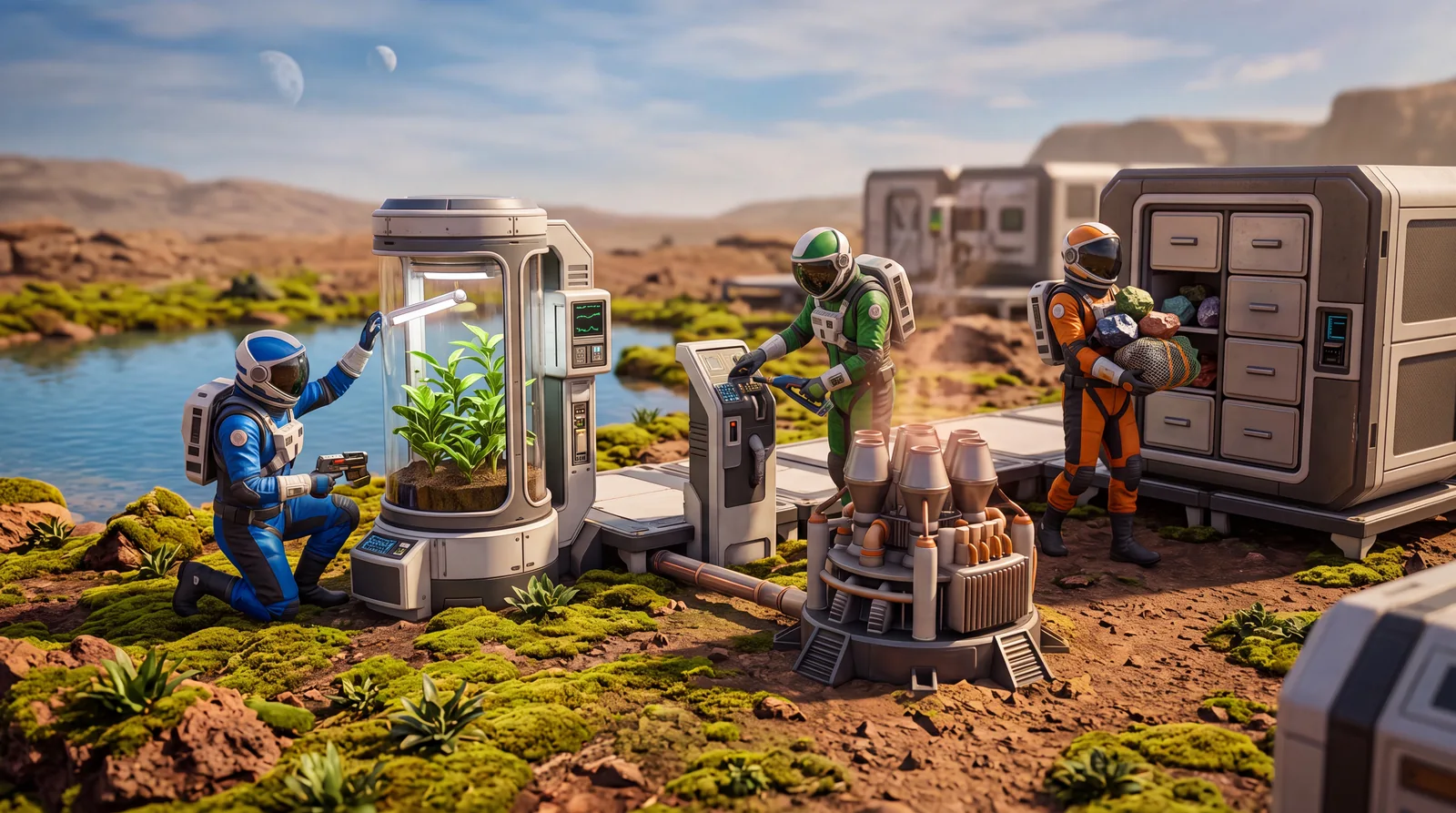
The Craft Station is your main crafting machine, and you upgrade it over time via the T2 Craft Station up to the Advanced Craft Station. This is where basic materials like Iron, Silicon, Titanium and Cobalt turn into everything you need to survive and terraform: backpacks, oxygen tanks, microchips for your Multitool, screens and the parts for bigger machines. Without a Planet Crafter Craft Station in reach you don't get anywhere, because even your most basic gear comes out of it.
The Advanced Craft Station unlocks at 175 kTi and is described in game as the place to "craft new advanced tools and blueprints". According to planetcrafter.th.gl, it's also where the condensed endgame parts come from: the Iridium Rod, the Uranium Rod, the Osmium Rod, the Super Alloy Rod and the Rocket Engine. The Quartz craft station, which unlocks via the System Terraformation Index, mainly makes quartz products such as Cosmic Quartz.
🌍 Where to put the Craft Station and the Ore Crusher
Early on, a compact setup right next to your starting pod works best: a Living compartment, a door, the Craft Station and a storage box packed into as little space as possible. You refill your oxygen inside the compartment, and your materials sit right next to the station instead of a long walk away.
The same idea applies to refinement machines like the Ore Crusher, with one addition. Put them as close as you can to your ore deposits, or next to the storage box where you dump your mined ore. That way you skip the long walks every time you refill the input or empty the output. Your Planet Crafter Craft Station can then sit in the main base, a short run away.
One thing a lot of new players miss: the Planet Crafter Craft Station and the Ore Crusher don't run on their own. Both need constant power. Build enough Wind turbines or solar panels before you place them. Otherwise your expensive T2 or T3 refinement just stops during a power shortage, and you might not notice for a while.
📦 Refinement: breaking ore into useful materials
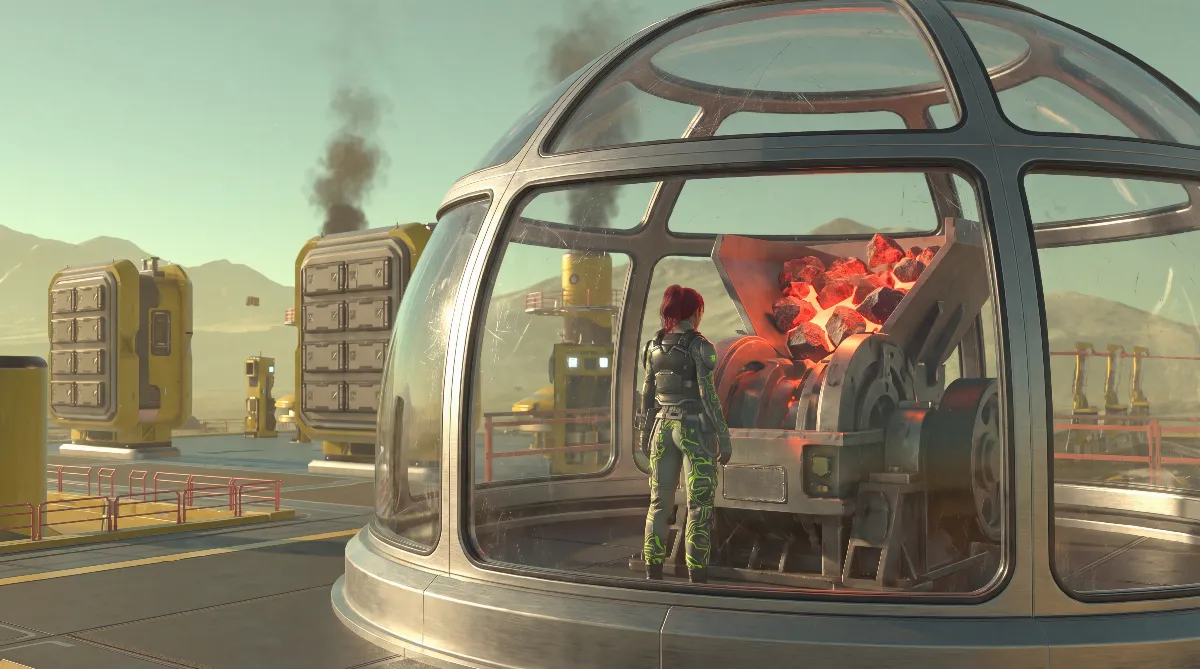
In The Planet Crafter, refinement mostly means breaking ore down into the basic materials the Planet Crafter Craft Station then turns into gear. The key machine is the Ore Crusher. In game it "breaks certain ores to extract multiple other ones from it". According to th.gl, all three crusher tiers unlock on Planet Humble, where Bauxite, Dolomite and Uraninite come from ore veins:
| Ore | Possible yield in the Ore Crusher |
|---|---|
| Bauxite | Aluminum (3x), Iron, Magnesium, Silicon |
| Dolomite | Cobalt (3x), Iron, Magnesium, Silicon, Titanium |
| Uraninite | Dolomite, Iridium, Iron, Super Alloy, Uranium |
Cosmic Quartz doesn't belong in this table: according to th.gl it isn't crushed but crafted the other way round, at the Quartz craft station, from Magnetar, Blazar, Pulsar, Quasar and Solar Quartz plus Zeolite, Osmium, Obsidian and a Nitrogen cartridge.
The Ore Crusher comes in three tiers, and the difference is big. According to planetcrafter.th.gl, the T1 crusher draws only 0.6 kW, the T2 Ore Crusher (unlocks at 25 kTi) 21 kW and the T3 Ore Crusher (unlocks at 1 MTi) 125 kW, with storage going from 12 to 20 to 30 slots.
Community guides add processing times of 130, 90 and 70 seconds per batch and 3, 4 and 5 resources per run. If you stick with the T1 for too long, you lose a lot of output and time compared to a setup with a T3 crusher.
On Toxicity a second loop joins in. The Detoxification machine purifies toxic elements and extracts Toxins; from Toxic water, for example, you get Purified water plus Toxins. The Craft Station - refinement works those materials further, for example a Purification capsule, two Purified water and a Pristine mushroom into Purification gel.
Keep this in mind when you plan: finished materials land in the machine's own output inventory, not in your storage box. If you keep forgetting to empty the Ore Crusher, you quietly block your own production. The output space is limited, and a full machine stops taking new ore.
🔗 Example: from raw ore to finished part
Here's one full chain that shows how the Ore Crusher feeds the Planet Crafter Craft Station. You collect Uraninite. The Ore Crusher turns it into, among other things, Iridium and Super Alloy. At the Advanced Craft Station, 9 Iridium become an Iridium Rod, and 8 Super Alloy plus Aluminum become a Super Alloy Rod. You need parts like these in the endgame for things like the Rocket Engine and the Ore Extractors.
Without the refinement step, you're standing at the Planet Crafter Craft Station with raw Uraninite and almost nothing to make from it.
That two-step flow is the core of the whole crafting system: refine first, then build. It holds from your first backpack to your last rocket.
💡 Tips for the Craft Station and refinement
- Build first, then gather: set up the Planet Crafter Craft Station and the Ore Crusher before you haul in big loads of ore. Otherwise you're carrying materials around for nothing.
- Use recycling: the Recycling machine "breaks items down into their core components". Handy when you crafted something you didn't actually need.
- Upgrade over duplicating: a T2 or T3 Ore Crusher almost always beats a second T1, because output per minute and per ore goes up noticeably.
- Run both loops on Toxicity: ore refinement in the Ore Crusher and toxin processing in the Detoxification machine and the Craft Station - refinement run side by side. If you only build one, you'll stall later on recipes that depend on the other.
- Watch the output: empty the Ore Crusher and the Detoxification machine regularly. Once the output is full, refinement pauses even with ore still waiting in the input.
In short, refinement pays off whenever a recipe asks for a material you can't mine directly. From the midgame on, that's almost always. Learn it early and you won't stand at the Planet Crafter Craft Station with a full storage box and nothing you can actually build.
❓ FAQ about the Planet Crafter Craft Station
Where should I put the Planet Crafter Craft Station?
The Craft Station works best right at your starting pod, inside or next to a Living compartment where you can refill oxygen. Put the Ore Crusher close to your ore or a collection box. Both need constant power from a Wind turbine or solar panels.
What does the Ore Crusher do?
It breaks ore into several materials at once. Bauxite, for example, gives Aluminum, Iron, Magnesium and Silicon. According to community guides, the T1 gives 3 resources per batch, the T2 gives 4 and the T3 gives 5.
Why can't I use raw ore at the Planet Crafter Craft Station?
Because almost all Craft Station recipes need refined materials. You refine ore in the Ore Crusher first, or toxic material in the Detoxification machine, and then craft with the results at the Craft Station or the Advanced Craft Station.
Where do I craft the Iridium Rod and the Super Alloy Rod?
According to planetcrafter.th.gl, the Iridium Rod, the Uranium Rod, the Osmium Rod and the Super Alloy Rod are all made at the Advanced Craft Station.
More Planet Crafter guides: the terraforming basics in our Planet Crafter beginner's guide, how to unlock more blueprints and microchips, the best base locations for your Craft Station and Ore Crusher, and everything about The Planet Crafter on PS5.
Checked against the item database on planetcrafter.th.gl and Miju Games' patch notes up to version 2.103 (Skeo update), as of October 2026. Station names, crafting stations, unlock values, power draw and storage of all three Ore Crusher tiers and the rod recipes match th.gl (the database writes power as "W", the game shows the same numbers in kW). Processing times and output counts per crusher tier come from community guides. Values can change with future updates.