SpaceCraft Hematite: Where to Find It, Drop Chances and the Crystallizer Trick (2026)
- ⚡ Quick check
- 🪨 What hematite actually is in SpaceCraft
- ⛏️ Every source of SpaceCraft hematite
- 💡 Why mining iron gets you practically nothing
- 📍 The reliable source: Iron Spherules in asteroid fields
- 📦 Basalt Shell: the ground source
- ✨ The Crystallizer trick: making SpaceCraft hematite yourself
- 💰 What it really costs
- 🔧 What you need SpaceCraft hematite for
- ❓ FAQ: hematite in SpaceCraft
- 🔗 In short
SpaceCraft hematite isn't something you pick up on the side while mining iron: the Ferrous Outcrop drops it with only a 1.8 % chance, and then exactly one. The crystal only becomes reliable in asteroid fields, or once you start making it yourself.
This is one of the most common early-game frustrations. In the official Steam discussions, one player reports mining around 2,000 SU of iron material from Siderite and Ferrous Outcrops and getting a grand total of one hematite, when he needed three for a thruster. This guide shows why that wasn't bad luck but math, and which three routes actually work.
⚡ Quick check
- SpaceCraft hematite is a crystal (loot level 3), worth 7.00 credits, taking 0.5 SU.
- Ground nodes are a trap: the Ferrous Outcrop drops it only 1.8 % of the time.
- Best source: the Iron Spherule in asteroid fields. 70 % of all breaks contain the crystal.
- On the ground: the Basalt Shell as a solid second source.
- The way out: the Crystallizer makes the crystal from Iron Ingots, but the recipe only unlocks through a lab study that costs ten hematite.
🪨 What hematite actually is in SpaceCraft
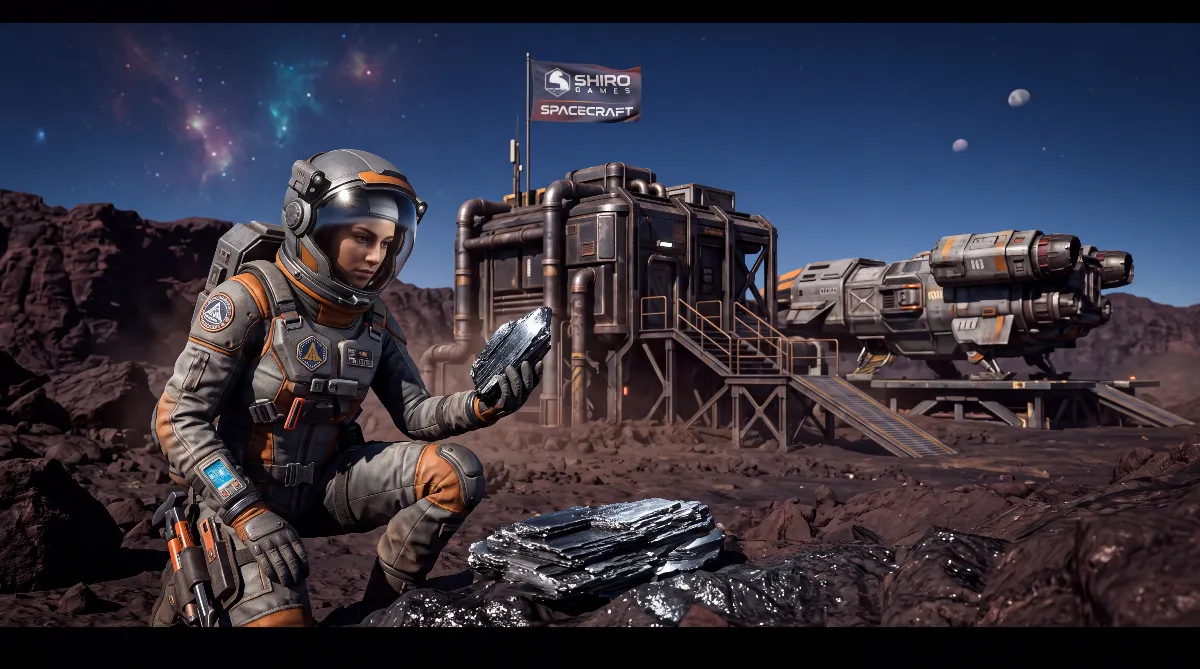
The item description is unusually precise: a crystalline iron oxide used in radiation shielding because of its high density, which is also electrically conductive. That explains its double role in the tech tree: it's both a simple iron source and a base material for electronics.
Important for planning: the game doesn't list it as ore but as a crystal. That's why it never shows up as the main yield of an ore vein, only ever as a side drop from other sources. If you treat it like iron ore and just mine more nodes, you're working against the system.
⛏️ Every source of SpaceCraft hematite
Eight sources have the crystal in their yield table. The gap between them is huge, though, and that's exactly what most players miss:
| Source | Tier | Type | Chance | Amount |
|---|---|---|---|---|
| Iron Spherule | 1 | Shell (asteroid) | 70 % | 3–6 |
| Basalt Shell | 1 | Shell | 22.4 % | 4–7 |
| Ferrous Outcrop | 2 | Node | 1.8 % | 1 |
| Siderite | 2 | Node | low | 1 |
| Bauxite Rock | 3 | Node | low | 1 |
| Magnetite | 4 | Node | low | 1 |
| Titanomagnetite | 4 | Node | low | 1 |
| Wolframite | 5 | Node | low | 1 |
For Siderite, Magnetite, Titanomagnetite, Wolframite and Bauxite Rock, the database lists it as a secondary yield without a reliable percentage for each node. The order of magnitude matches the Ferrous Outcrop. None of them work as a farming strategy.
💡 Why mining iron gets you practically nothing
Run the numbers once and the frustration from the Steam thread turns into a simple figure. The Ferrous Outcrop drops it 1.8 % of the time, and exactly one. The expected value per mined node is 0.018 hematite.
The Iron Spherule, on the other hand: 42 % of the time you get 4 to 6, and another 28 % of the time 3 to 5 on top of Iron Nuggets. That's an expected value of about 3.2 per spherule.
That's the core of this guide: a single Iron Spherule gives as much on average as about 180 Ferrous Outcrops. No gear upgrade and no better laser makes up for that factor. It's simply the wrong kind of source.
📍 The reliable source: Iron Spherules in asteroid fields
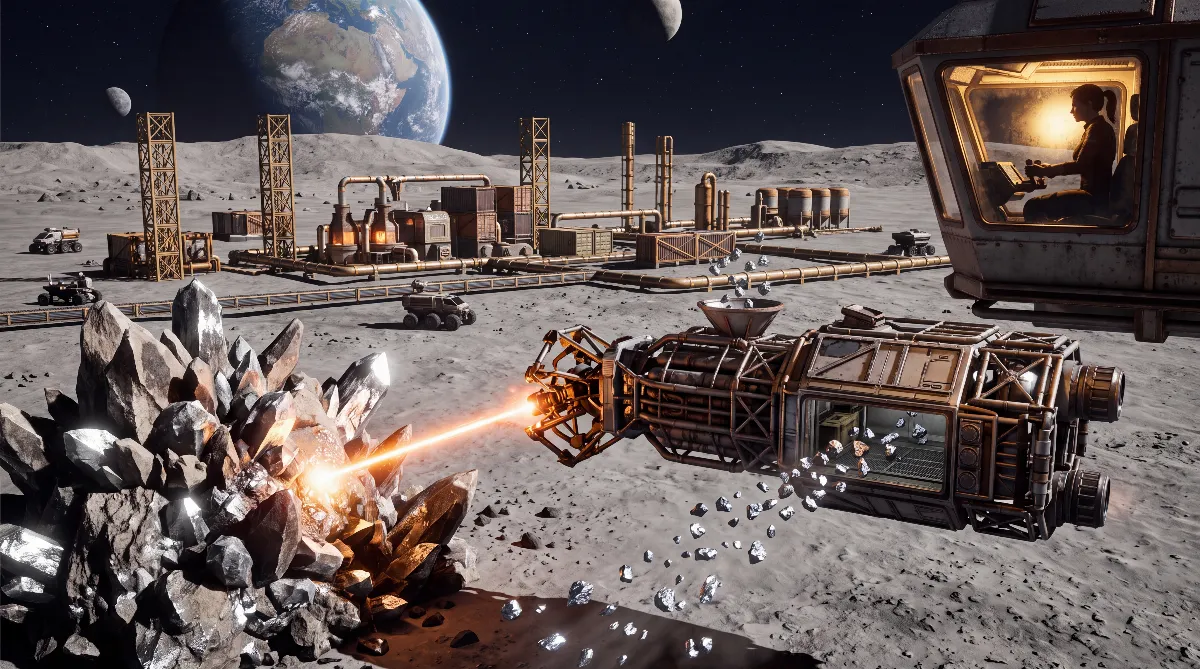
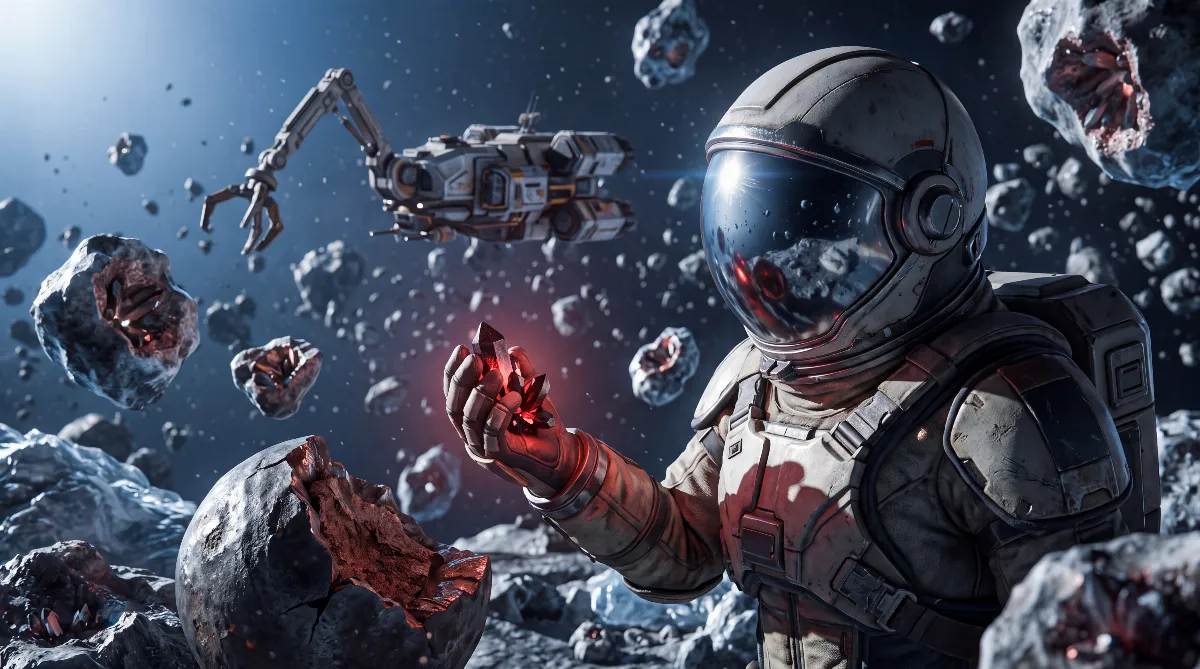
The Iron Spherule is a tier 1 shell that only appears in asteroid fields. Shells work differently from nodes: you break them open and get exactly one of several possible outcomes. It's a draw, not a mixed yield.
| Chance | Yield |
|---|---|
| 42 % | Hematite 4–6 |
| 28 % | Iron Nugget 3–9 and Hematite 3–5 |
| 14 % | Iron Nugget 0–2 and Beautiful Gemstone 2–3 |
| 10.5 % | Iron Nugget 0–2 and Calcified Invariant 1 |
| 3.5 % | Iron Nugget 0–2 and Marvelous Gemstone 1 |
| 2.1 % | Iron Nugget 0–2, Fair Gemstone 4–6 and Beautiful Gemstone 2–3 |
The single values are rounded, so the column adds up to 100.1 instead of 100 %. Seven out of ten breaks contain the crystal you're after. The side effect is almost more valuable: roughly every tenth spherule drops a Calcified Invariant, and almost a fifth give gemstones. That makes the Iron Spherule one of the most rewarding objects in early SpaceCraft, once you get there.
The chicken-and-egg problem
This is exactly where the player from the Steam thread got stuck: he wanted to build the thruster before flying to the asteroid field, and the thruster needs the crystal. That order doesn't work. In the short term only the Basalt Shell helps; the Crystallizer only becomes the answer once you've collected enough for the lab study. Both are covered below.
📦 Basalt Shell: the ground source
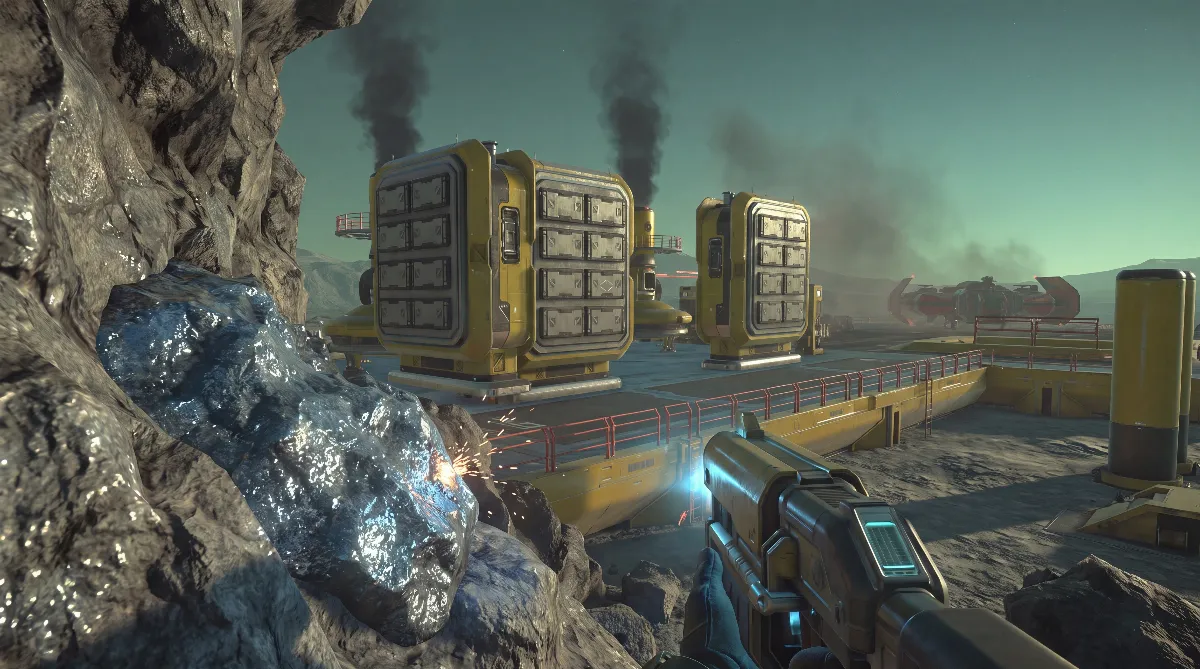
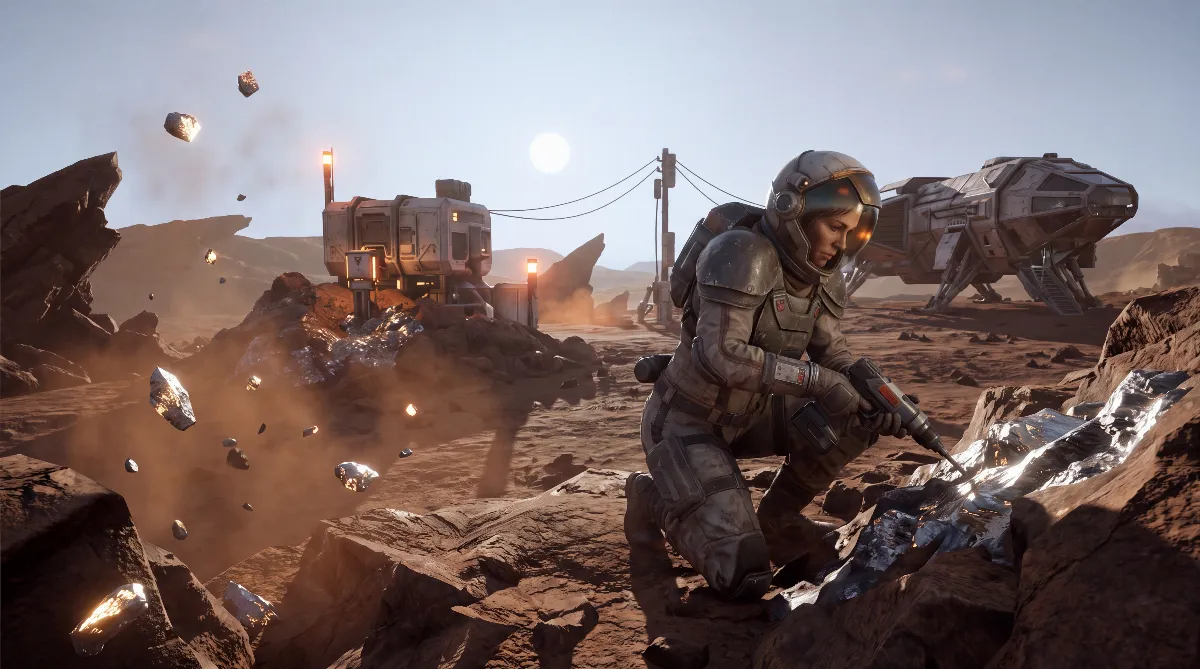
The Basalt Shell is also a tier 1 shell, but it sits on planet surfaces. It has eleven possible outcomes, and three of them contain the crystal: 14.6 % for 4 to 6, 4.9 % for 4 to 6 together with Calcite, and 2.9 % for 5 to 7 together with Quartz.
That adds up to 22.4 % and an expected value of about 1.1 per shell. That's about a third of the Iron Spherule, but still roughly sixty times a Ferrous Outcrop, and you get there without an asteroid trip. You also pick up Titanium Ore, Silicate and Calcified Invariant along the way.
Finding shells in the first place comes down to scanning. The guide to finding resources explains how detector and Scanalyzer work together and why the Mining Bureau isn't a resource catalog.
✨ The Crystallizer trick: making SpaceCraft hematite yourself
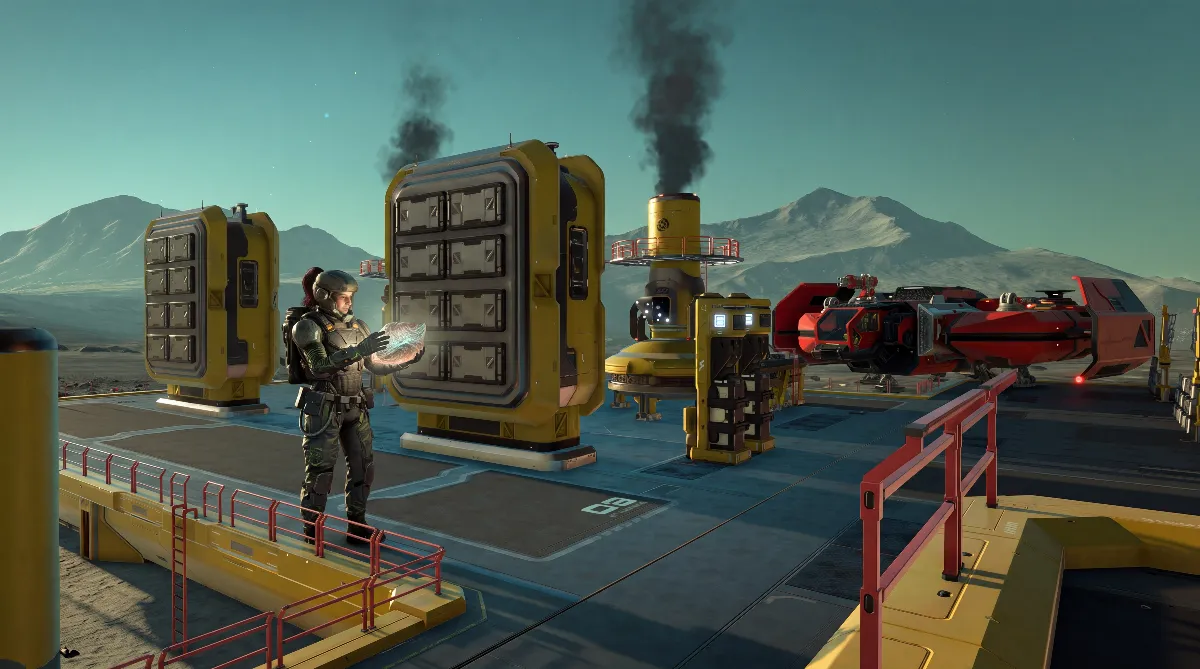
This is the part hardly any guide mentions, even though it solves the problem for good. The Crystallizer has a recipe that outputs hematite:
| Station | Ingredients | Result | Duration |
|---|---|---|---|
| Crystallizer | 50× Iron Ingot, 1× h-Crystal Matrix | 40× Hematite | 1 hour |
| Workshop | 1× Hematite | 7× h-Crystal Matrix | 3 seconds |
Important: neither recipe is available from the start. According to spacecraft.tools, they only unlock with the lab study Hematite II. It uses 10 hematite and runs for 30 minutes.
After that, the two recipes form a self-sustaining loop. A single hematite becomes seven h-Crystal Matrices in the Workshop. Each of those powers one Crystallizer run with 50 Iron Ingots and turns into 40 hematite.
So one hematite and 350 Iron Ingots become 280. And iron, as the resource guide explains, is plentiful on practically every planet. You only need to find the crystal until the study is done: ten for the research and one seed for the first matrix. After that it's a production problem, not a search problem.
💰 What it really costs
Honestly calculated, the Crystallizer isn't a money maker but an availability fix:
| Item | Amount | Value |
|---|---|---|
| Iron Ingots and matrix used | 50 + 1 | about 290.50 credits |
| Crystals produced | 40 | 280.00 credits |
| Balance per run | – | 10.50 credits loss, plus crafting tax |
So you pay a little over 10 credits and an hour of run time to make a scarce crystal plannable, and the crafting tax widens the loss further. Once you're mining iron automatically anyway, that's a very good trade. If you're optimizing for credits, sell the Iron Ingots directly instead. The crafting chains guide fits here.
🔧 What you need SpaceCraft hematite for
- Iron Ingot: in the Smelter, 1 hematite becomes 1 Iron Ingot. Fine as a way to use spares, a waste as an iron source.
- h-Crystal Matrix: in the Workshop, 1 hematite makes 7 matrices. By far the best conversion ratio in the game.
- "Voidseeker" Thruster: in the Workshop from 2 Small Steel Part Casings, 4 Support Hardware, 3 Hall Alternators, 6 Thermal Sheets and 3 hematite. Base value per spacecraft.tools: 890 credits.
- Research: the lab studies for the crystal use it too, according to the same database 1, 10, 50 and 200 for stages I to IV. Stage II unlocks the Crystallizer loop.
The "Voidseeker" Thruster is made by the manufacturer Damona and, according to its description, is meant to bring explorers back to safe space quickly. Which thrusters and modules are worth it otherwise is covered in the upgrades guide.
❓ FAQ: hematite in SpaceCraft
Where do I find SpaceCraft hematite fastest?
In asteroid fields at Iron Spherules. 70 % of all breaks contain the crystal, about 3.2 per spherule on average. On the ground, the Basalt Shell is the best alternative.
Why don't I get hematite from mining iron?
Because the Ferrous Outcrop drops it only 1.8 % of the time, and then just one. That's 0.018 per node, so you'd have to mine about 180 nodes on average to match a single Iron Spherule.
Can I craft hematite instead of searching for it?
Yes, once the lab study Hematite II is done. It costs 10 hematite and runs for 30 minutes. After that the Crystallizer turns 50 Iron Ingots and 1 h-Crystal Matrix into 40 hematite in an hour. The matrix comes from the crystal itself, one hematite makes seven matrices in the Workshop. A single seed is then enough for your whole production.
Does the Crystallizer pay off financially?
No, not in credits: each run puts in about 290.50 credits and gets 280.00 back, a loss of 10.50 credits, and the crafting tax widens the loss. The gain is in reliability, not money.
Is hematite an ore in SpaceCraft?
No, the game lists it as a crystal with loot level 3. That's why it never appears as the main yield of a source, only as a side drop, which matters a lot for farm planning.
How much storage does hematite need?
0.5 SU per unit. At 7.00 credits, that makes it one of the densest cargos in SpaceCraft. 40 crystals from one Crystallizer run take only 20 SU.
🔗 In short
- Hematite is a crystal in SpaceCraft, not an ore, and only drops as a side yield.
- The Iron Spherule in asteroid fields beats any ground node by a factor of about 180.
- The Basalt Shell is the best source until you reach asteroid fields.
- After the lab study (ten hematite), one seed crystal and Iron Ingots make you independent through the Crystallizer.
Which other crystals and ores are worth it early is covered in the rare resources guide.
As of October 2026, SpaceCraft Early Access v0.5.25674 (Shiro Games). Recipe, unlock and values checked against spacecraft.tools, names against our German item database, changes against the patch notes up to Major Update #1 and v0.5.25674. The farming story comes from the official Steam discussions and is a community report without official confirmation. Drop chances and recipes can change with patches.