SpaceCraft Crafting Chains: Using Recipes the Right Way (2026)
- 🔗 The three stages of every chain
- 💰 When refining pays off
- ⚠️ The most common beginner mistake
- 🧮 Estimating the real material value
- 📋 A worked example
- 🏭 When SpaceCraft crafting chains branch out
- 🔓 Permits as gatekeepers of the chain
- 💡 Pro tips
- 📦 Organize storage by chain, not alphabetically
- 🚫 Common mistakes
- ❓ FAQ: SpaceCraft crafting chains
If you sell raw ore straight on the market in SpaceCraft, you're often leaving credits on the table. SpaceCraft crafting chains are the heart of the economy: every refining step usually adds value, but costs time and material.
This guide shows how SpaceCraft crafting chains are structured, with examples from the game data, and when refining really pays off. How to automate production is covered in the base automation guide.
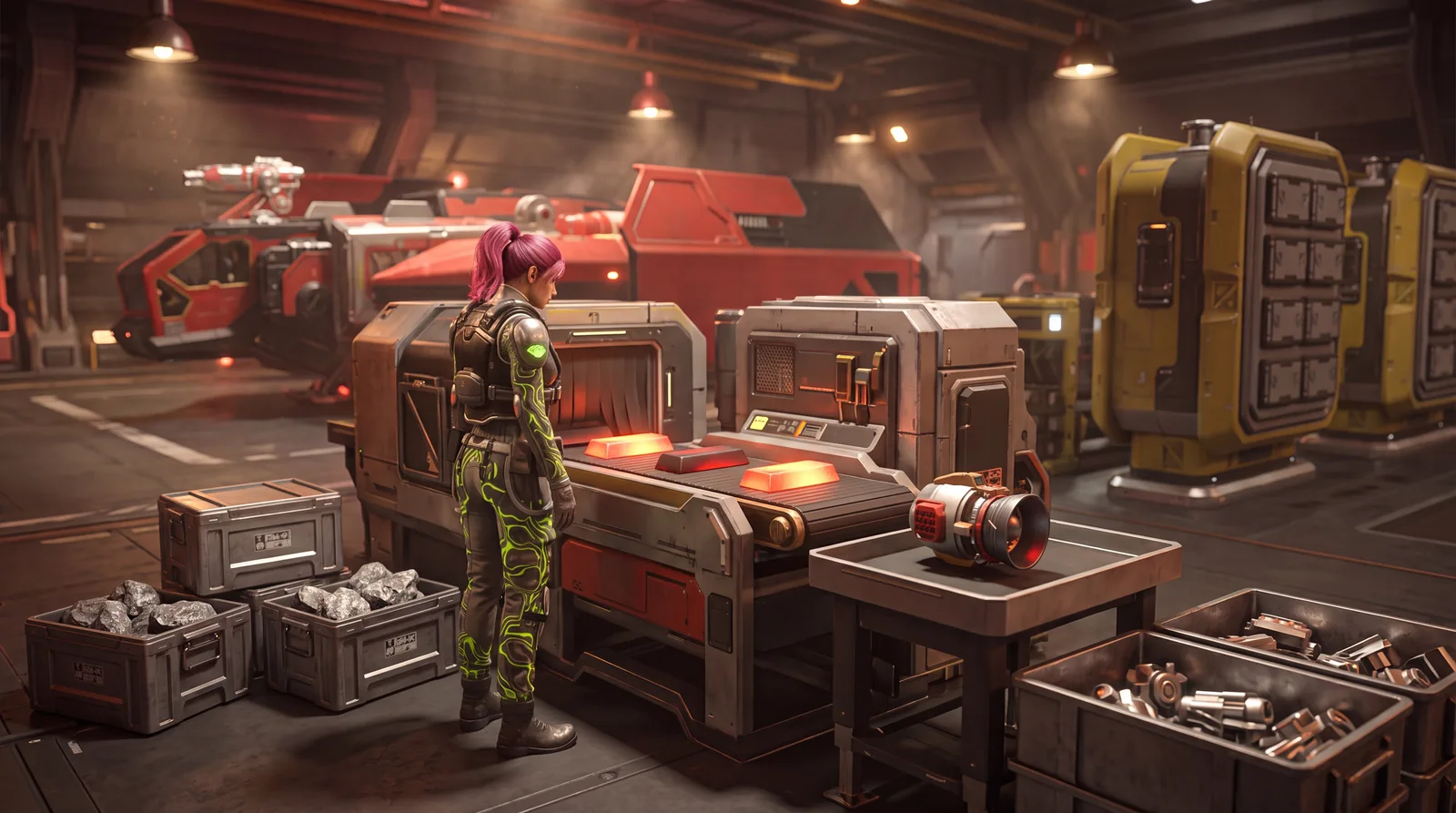
🔗 The three stages of every chain
Almost every production chain in SpaceCraft follows the same pattern:
| Stage | Station | Example |
|---|---|---|
| 1. Ore | Mining with a mining laser or Extractor | Iron Ore, Copper Ore, Quartz |
| 2. Ingot | Smelter | Iron Ingot, Copper Ingot |
| 3. Component | Workshop, or automated in the Assembler | Wire, Magnetic Coils, ship parts |
Advanced products go further through the Chemical Factory, Crystallizer or Factory, but the principle stays the same: every stage needs the previous one as an ingredient. A component can't be crafted without the ingot in stock, no matter how much raw ore sits in storage. That's exactly why it pays to sort your storage by chain instead of piling everything into one big warehouse. If you produce automatically, you can carry that split straight into your base's storage layout.
💰 When refining pays off
Rule of thumb: never sell raw ore you'll need again soon. Crafted ship parts like thrusters, generators or cargo holds bring far more credits than the same amount of raw material. The effort usually pays off as long as you have time rather than needing cash right now.
The exception: if you need credits quickly for something specific (say Silicone Gel for your next cargo hold), sell the least important surplus material instead of emptying your whole storage.
⚠️ The most common beginner mistake
Many new players sell copper or Quartz too early because it feels like quick money, and only later realize that exactly this material is needed for Wire, Crystalline Focusers, cargo holds or Magnetic Coils. The result: the next crafting step stalls, and you have to fly out again to get the same material back.
Practical rule: keep copper, iron, Quartz, Silicone Gel and active scan samples as long as you're not sure your next goal doesn't need them. Only when a material is definitely surplus does it go to market.
🧮 Estimating the real material value
The true value of a component only shows once you unroll the whole chain backwards: every ingredient, every intermediate step. If you buy ingredients at the Trade Nexus, there's also 8 % buying tax on top since patch v0.3.22866 of July 21, 2026; before that it was 20 %. More on that in the Trade Nexus guide. If you craft a lot, check now and then whether a component is still worth the effort.
📋 A worked example
An example with base values from spacecraft.tools: 2 Tungsten Ore (6 credits each) make 1 Tungsten Ingot worth 16 credits in the Smelter. So the ingot is worth 4 credits more than the ore. 4 Platinum, 4 Tungsten and 1 Silicon Ingot (138 credits together) become 6 Unbendinium Ingots worth 154.80 credits.
It gets even clearer on the farm: 1 Spacekorn Seed has a base value of 0 credits, while the Xenic Oil made from it is worth 16 credits. Then again, not every stage pays off equally. So do the math before big batches instead of crafting by feel.
🏭 When SpaceCraft crafting chains branch out
From a certain stage on, a single raw material chain feeds several end products at once. Iron Ingots, for example, go into both hull parts and tools. Once that happens, it pays to check your stock regularly so a popular intermediate doesn't run short for all end products at the same time. More on wiring Extractor, Smelter and drones in the base automation guide.
🔓 Permits as gatekeepers of the chain
Not every refining step is open to you from the start. The Modular Systems 2 permit, for example, is what unlocks the Module Kit, Strong Metal Sheet and the Cargo Hold. Without the right permit, lab study or experience level, even a full storage won't get you access to higher-value recipes. So before you build a chain, check the permit menu: a missing unlock is often the real blocker, not a lack of raw materials. Which permits pay off first is explained in the permits guide.
💡 Pro tips
- Before selling, quickly check: do I need this for my next blocker (permit, component, quest)?
- Buffer raw materials that several chains need at once instead of restocking them one at a time when needed.
- If you're unsure whether a recipe pays off, work through the full ingredient tree once.
- Since Community Update #1, the Workshop and Smelter also craft intermediate products automatically through the queue.
📦 Organize storage by chain, not alphabetically
A simple but effective trick: don't sort storage randomly but by production chain, so all ingredients for propulsion tech go in one area and everything for hull parts in another. Once several chains run at once, you save constant searching and see at a glance where supply is missing.
🚫 Common mistakes
- Selling raw ore that you need for a recipe shortly after
- Emptying your entire storage for quick credits instead of selling only surplus
- Trying to craft advanced components without the previous stage (ingots) in stock
- Never checking the actual profit margin and crafting recipes that barely pay off
In short: SpaceCraft crafting chains pay off because ore earns the least when you sell it directly and the most when you process it all the way. If you use that lever consistently, you'll earn noticeably more credits from the same amount of mining.
❓ FAQ: SpaceCraft crafting chains
Should I always refine ore before selling it?
Usually yes, processed components bring far more credits. Exception: you need money right away and the raw material isn't earmarked for anything current.
How do I find out whether a recipe pays off?
Work through the full ingredient chain, and add the 8 % Trade Nexus buying tax for any ingredients you buy.
What do I do if I run out of the base material mid-chain?
Fly back to the source or, if automated, check the Extractor capacity. Often the output is simply too low.
What if I can't mine an ingredient myself at all?
Then there's the market: intermediates like ingots or components can be bought at the Trade Nexus, and since Major Update #1 also through your own buy orders.
As of October 2026, SpaceCraft Early Access v0.5.25674. Checked against the spacecraft.tools game database (recipes, base values), our SpaceCraft database and Shiro Games' patch notes on Steam. Recipes and prices can change with patches.