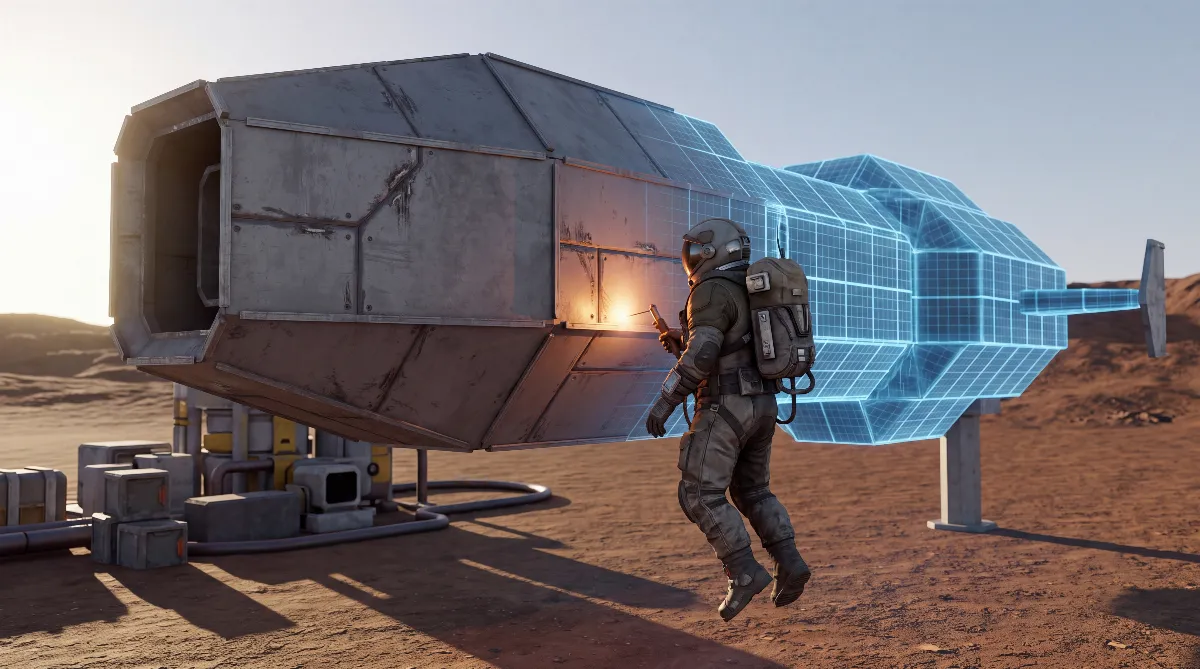
Space Engineers 2 Blocks: Every Block Type, Armor and Components Explained
- 📐 The Size Logic: 25 Centimeters Instead of Small and Large Grid
- 🛡️ Light or Heavy Armor: The Numbers Behind It
- 🧱 Space Engineers 2 Block Categories at a Glance
- ⚒️ Components: Why Part 2 Has No More Ingots
- 📅 What Has Been Added Since the Early Access Launch
- 🔜 Announced but Not Yet in the Game
- 💡 Six Rules for Choosing Your Blocks
- ❓ Frequently Asked Questions about Space Engineers 2 Blocks
- ✨ Conclusion
Space Engineers 2 blocks fall into armor, structure, function, mechanical, weapons and decoration, and they are no longer split into small grid and large grid but named by their edge length in meters. The difference that matters most while building: a light armor cube costs a single Steel Plate, a heavy one takes roughly five times as much punishment.
This guide sorts the block catalog by category, compares light and heavy armor with real numbers, explains why part 2 has no more ingots, and uses Keen's official posts to show what has actually been added since the Early Access launch on January 27, 2025.
📐 The Size Logic: 25 Centimeters Instead of Small and Large Grid
The biggest change from the first game is not a single block but the grid underneath. Keen Software House describes it on the official features page as a “new 25cm unified grid system (no more small vs. large grids!)”. There are no longer two separate building worlds you have to pick between before placing your first block.
Instead, everything sits on a grid with 25-centimeter steps, and the game adjusts snapping automatically to the block size you have selected. In practice, you can place a large hull plate and a small console block right next to it without a subgrid or adapter in between.
The size shows up directly in the block names. The Space Engineers 2 wiki on wiki.gg has entries like “Light Armor Slope 0.5 m”, “Cockpit 1.5 m”, “Drill 3.5 m” or “Gravity Generator 5 m”. That wiki is a community collection, not a block list published by Keen, so its values are useful but not officially confirmed.
🛡️ Light or Heavy Armor: The Numbers Behind It
The most common building decision is also the worst documented one: light or heavy armor. The following values come from the community wiki and have not been published by Keen. They are consistent across several block pages, though, which makes them the best available basis.
| Block (0.5 m) | Mass | Integrity | PCU | Components |
|---|---|---|---|---|
| Light Armor Cube | 33.1 kg | 52.96 | 1 | 1x Steel Plate |
| Heavy Armor Cube | 94.4 kg | 302.08 | 1 | not listed in the wiki |
Run the numbers against each other and you get the real answer: heavy armor weighs 2.85 times as much and holds 5.7 times as much. Per kilogram of mass it delivers exactly twice the integrity of light armor, 3.20 versus 1.60 points per kilogram.
That flips the rule of thumb that heavy armor is “too heavy”. Wherever you need protection anyway, it is the more efficient choice. Light armor only wins where volume and shape matter: cladding, interior walls, outer shells. The PCU value is identical for both, so the performance budget does not decide it.
🧱 Space Engineers 2 Block Categories at a Glance
As of September 2026, the community wiki's block catalog lists around 330 block pages in 33 categories. Sorted by purpose, they boil down to six groups:
| Group | Includes, among others | What it is good for |
|---|---|---|
| Armor | Light Armor, Heavy Armor, slopes, corners, half variants | hull, protection, shape: by far the largest share of any build |
| Structure | Truss Blocks, Catwalk, Handrail, Passage, Window | open frames, walkways, walkable interiors |
| Function | Cockpit, Control Seat, Battery, Solar Panel, Cargo Container, Conveyor, Drill | everything that moves power, material or control |
| Mechanical | Rotor, Piston, Hinge, Wheel Suspension | moving parts: turrets, elevators, wheeled chassis, hatches |
| Weapons | Gatling Gun, Gatling Turret, Rocket Launcher, Rocket Turret, Warhead | defense and targeted destruction |
| Display and decor | LCD family, Corner Light, Bed, detailing pieces | information, lighting, interior design |
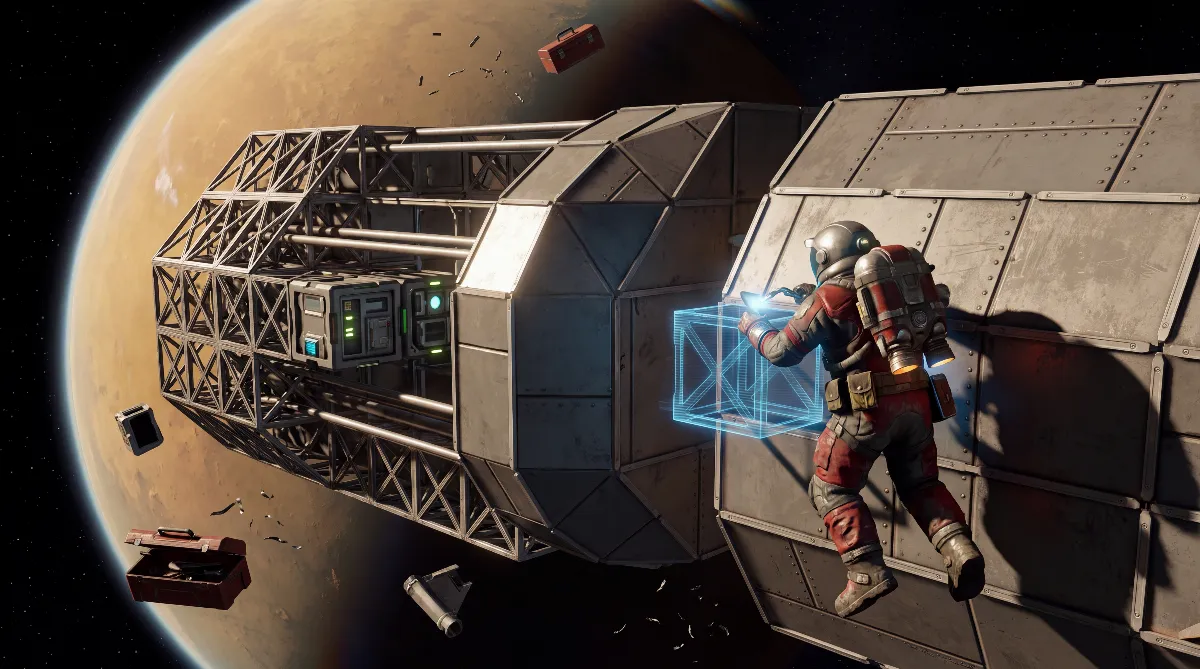
One detail that is easy to miss: according to Keen, Truss Blocks are “lightweight, open-frame pieces” for frames and support beams. If you use them instead of armor plates for interior scaffolding, antenna masts or docking arms, you save mass in places where protection does not matter anyway.
⚒️ Components: Why Part 2 Has No More Ingots
The second big break from part 1 concerns the components every block is made of. In its official Smelter preview from May 26, 2025, Keen explained that the Smelter converts raw ore directly into simple components. The ingot stage that was mandatory in Space Engineers 1 is gone entirely.
That noticeably shortens the chain. Ore becomes simple components, the Assembler turns simple components into complex components, and only the Fabricator combines refinery products and complex components into hi-tech components.
The community wiki currently lists thirteen simple components: Steel Plate, Steel Tube, Glass, Electronic Parts, Motor, Construction Component, Wire, Turbine Blades, Metal Grids, Magnesium Powder, Lead Bar, Gold Thread and Chrome Coating. Keen has not published this list as an official overview; it is a community collection.
For day-to-day building, the distribution matters more than the list: armor uses almost nothing but Steel Plate, and you need absurd amounts of it. Where your iron comes from and which terrain gives which ore is covered in the guide on finding ores and resources.
📅 What Has Been Added Since the Early Access Launch
Space Engineers 2 launched on January 27, 2025 as a Playable Alpha, with a very slim block catalog back then. This overview is based on Keen Software House's release posts:
| Date | New blocks |
|---|---|
| April 3, 2025 | Conveyor Adaptor Straight, Conveyor Adaptor End, 13 conveyor tube variants |
| April 24, 2025 | Prototype Door, Truss Blocks, additional armor shapes |
| May 29, 2025 | Bed (decorative at first), Armor Half Corner, Armor Half Tall Slope Inverted |
| March 23, 2026 | “Mechanical Blocks & Weapons”: Rotor (1.25 m and 0.5 m), Piston (4 m and 2.5 m), Gatling Gun and Gatling Turret |
| July 6, 2026 | “Drive, Automate & Detonate”: wheels in six sizes, Hinges, Wind Turbine, Event Controller, Timer, Sensor, Control Panel, Sound Block, Rocket Launcher and Rocket Turret, Warheads, LCD family, a set of nine Passage blocks, Catwalk Stairs Wide Half and Narrow Half |
| August 17, 2026 | “Smoother, Stable & Faster”: no new blocks, focus on performance and usability instead |
Some context for the July update: Keen explicitly calls wheels and hinges “the final Mechanical Blocks” there. From the developer's point of view, the mechanical category is complete. If you are waiting for more moving base pieces, you are probably waiting in vain.
One more piece of context that most overviews miss: since August 13, 2026, Keen no longer assigns Vertical Slice numbers to updates. There is no “VS2.4”; updates now only carry descriptive names.
🔜 Announced but Not Yet in the Game
In his Dev Diary from September 3, 2026, Marek Rosa showed several new blocks that have not shipped yet. Treat them as a preview, not as part of the game:
- Cables: functional and decorative at the same time. According to the post, “Cables also transfer electricity (as any other grid block)”. You can attach buttons, lights and other parts to them.
- Interior decoration: Coffee Machine, Recycle Bin, Generic Lab Equipment, Laptop and Fire Extinguisher, meant by Marek as “a better starting point for decorating the inside of your rooms”.
No date was given for any of these. They are announced, not confirmed, and in Early Access anything can still change before release.
💡 Six Rules for Choosing Your Blocks
- Heavy armor where protection counts. It delivers twice the integrity per kilogram of light armor, so the mass is better invested than the weight suggests.
- Light armor for shape, not protection. Cladding, interior walls, aerodynamic shells.
- Truss instead of armor plate for scaffolding. Open frame pieces save mass where nothing will shoot at you.
- Rough first, then detail. Big pieces set the hull, small ones refine it; the 25 cm grid allows both on the same grid.
- Use mechanical parts sparingly. Every rotor, piston and hinge creates a moving joint, and those suffer first in collisions.
- Save a blueprint before major rebuilds. Block names and values change with every Early Access update. How saving and placing works is explained in the blueprint guide.
If you are planning your first ship and want to know which parts are mandatory on board, the guide to building your first ship with grids and thrusters picks up from here.
❓ Frequently Asked Questions about Space Engineers 2 Blocks
Does Space Engineers 2 still have small grid and large grid?
No. Keen officially describes the building system as a 25 cm grid without a split between small and large grids. Block sizes appear as a meter value in the block name instead.
Is heavy armor worth it despite the mass?
Going by the community wiki values, yes: the heavy cube weighs 2.85 times as much as the light one but holds 5.7 times as much. Per kilogram you get twice the integrity. Keen has not officially confirmed these numbers.
Why don't I need ingots anymore?
Because, according to Keen's own preview, the Smelter turns raw ore directly into simple components. The ingot stage from Space Engineers 1 was removed without replacement.
How many blocks does Space Engineers 2 have right now?
As of September 2026, the community wiki lists around 330 block pages in 33 categories, with every size variant on its own page. Keen does not give a total.
Will more mechanical blocks be added?
Probably not. Keen explicitly calls the wheels and hinges from the July update the final mechanical blocks.
What new blocks are coming next?
Cables and several interior decoration pieces have been announced without a date. Both come from the Dev Diary of September 3, 2026, and are not in the game yet.
✨ Conclusion
To understand Space Engineers 2 blocks, you only need to remember two things: the grid is unified and measures 25 centimeters, and the block size is in the name. Everything else is a question of purpose: armor for protection, truss for scaffolding, mechanical parts for movement, and components in the form of Steel Plate in quantities you will underestimate at first.
All information was checked against Keen Software House's official sources: the features page, the weekly release posts from April 3, April 24 and May 29, 2025, the Smelter and production chain previews from May 26 and July 1, 2025, and the release posts for “Mechanical Blocks & Weapons” (March 23, 2026), “Drive, Automate & Detonate” (July 6, 2026) and “Smoother, Stable & Faster” (August 17, 2026).
The preview of cables and decor blocks comes from Marek's Dev Diary of September 3, 2026. Block values, the component list and the block count come from the community wiki on wiki.gg and are not confirmed by Keen; they are marked as such in the text. As of: October 8, 2026.