Graveyard Keeper 2 Alkali: Recipe, Runes and Mixes
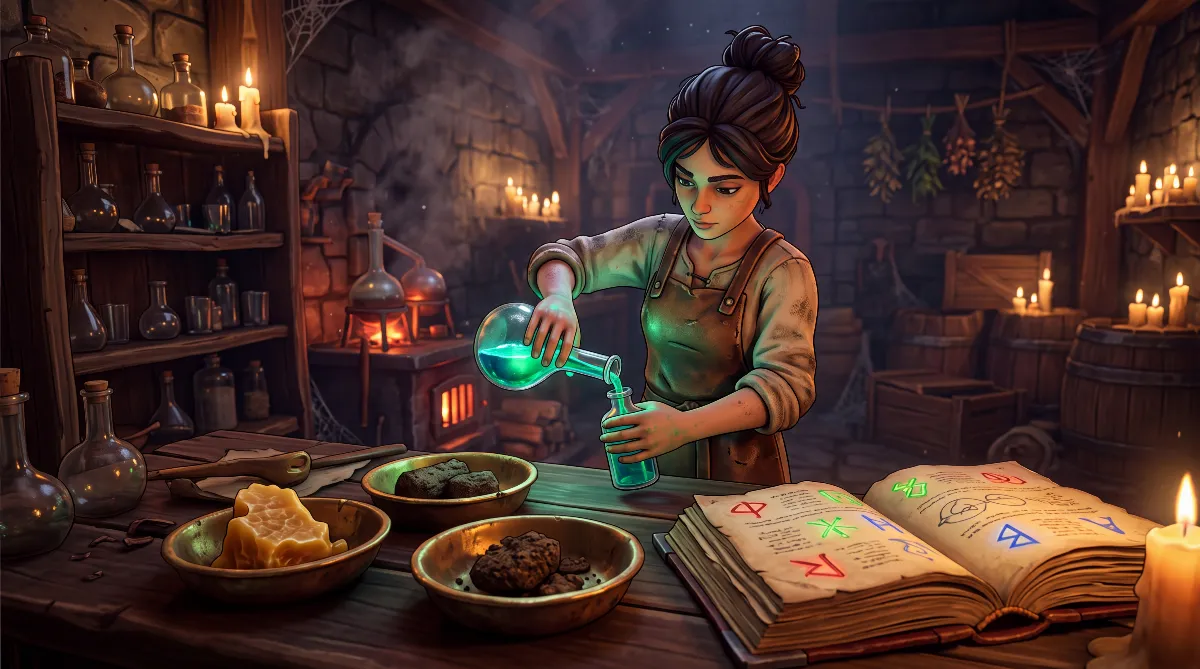
- 🧪 The Alkali Recipe at a Glance
- 🔢 Why It Doesn't Work Without Laboratory II
- ⚗️ Mixes That Work for Graveyard Keeper 2 Alkali
- 🧭 Step by Step in the Laboratory
- 🍯 Which Mix Makes Sense Day to Day
- 📦 What Ten Batches Really Cost
- ⚔️ What You Need Alkali For
- ⚠️ Common Graveyard Keeper 2 Alkali Mistakes
- ❓ FAQ: Graveyard Keeper 2 Alkali
You brew Graveyard Keeper 2 Alkali in Laboratory II from three ingredients that add up to exactly 1 red, 4 green and 2 blue runes. The simplest mix with rune values we checked in the game is Beeswax plus two Peat. The two-slot Laboratory I never gets there.
This guide lists the mixes that work with common ingredients, the math behind them and what you actually need Alkali for. Anything that only comes from the community wiki is marked.
🧪 The Alkali Recipe at a Glance
Alkali isn't a raw material, it's an alchemy formula. There's no fixed ingredient list, only a rune total that you have to hit exactly with whatever ingredients you like. How the rune system works in general is explained in our Graveyard Keeper 2 alchemy guide.
| Property | Value |
|---|---|
| Rune total | 1 red, 4 green, 2 blue (7 runes) |
| Station | Laboratory II (three ingredient slots) |
| Cost per brew | 1 Alchemy Flask plus fuel |
| Simplest checked mix | Beeswax + Peat + Peat |
| Used for | Master Sword (per community wiki) |
You can always recognize the formula by its rune total in the Folio, the game's rune book.
🔢 Why It Doesn't Work Without Laboratory II
The recipe needs seven runes. None of the common ingredients carries more than three: Beeswax has three, Tin and Copper Nugget also have three, Peat and Flour two each. Two ingredients top out at six runes, so the total always ends up one rune short.
The community wiki graveyard-keeper.wiki backs this up: there's no two-ingredient mix for Alkali at all. It counts the formula among six recipes that only work in Laboratory II with its third slot. The other five are Berserker III, Reanimation Liquid, Umami, the Philosopher Stone and Tannin Liquid.
You build Laboratory II from the alchemy lab's build menu. Plan it in before you start collecting ingredients for Alkali.
⚗️ Mixes That Work for Graveyard Keeper 2 Alkali
The trick with this formula: it wants exactly one red rune. So you pick an ingredient with exactly one red first and fill the other two slots with green and blue. The table separates mixes whose rune values we checked in the game's Folio from community values.
| Mix | Math (red/green/blue) | Status |
|---|---|---|
| Beeswax + Peat + Peat | 1/2/0 + 0/1/1 + 0/1/1 | Runes checked in game |
| Beeswax + Flour + Minced Meat | 1/2/0 + 0/2/0 + 0/0/2 | Runes checked in game |
| Beeswax + Flour + Zombie Goo | 1/2/0 + 0/2/0 + 0/0/2 | Zombie Goo from community |
All three rows add up exactly. We didn't brew every mix in the game, but the rune values of Beeswax, Peat, Flour and Minced Meat come straight from the Folio. Zombie Goo carries 2 blue runes according to wikily.gg.
🧭 Step by Step in the Laboratory
The routine is the same for every alchemy formula in Graveyard Keeper 2. For Alkali it goes like this:
- Prepare the lab: build Laboratory II, fill the Flask shelf and add fuel.
- Research ingredients: study Beeswax and Peat, or Flour and Minced Meat, once at the Study Table.
- Fill the slots: put in three ingredients and check the rune display. It has to show exactly 1 red, 4 green and 2 blue.
- Brew: start the process. According to the community wiki, a successful mix is saved in the Folio, so you don't need to write it down.
If the display doesn't match, Graveyard Keeper 2 won't start the recipe at all. Swap an ingredient instead of adding more, because every extra rune only pushes the total further off.
🍯 Which Mix Makes Sense Day to Day
For most saves, Beeswax + Peat + Peat is the easiest choice. According to the community wiki, Peat comes from the compost heap, which turns Leaves into Peat, and Leaves drop with every harvest anyway. If you already make fertilizer, you probably have a stock. More on that in the Graveyard Keeper 2 fertilizer guide.
The second option, Beeswax + Flour + Minced Meat, gets two of three ingredients from the Millstone. You grind Flour from wheat there, and Minced Meat also comes from the Millstone once the matching cooking technology is unlocked. That's handy when your compost heap is being emptied for fertilizer.
Beeswax is the bottleneck either way. Per the rune table it's the only ingredient with exactly 1 red and 2 green, and it's also a common ingredient for the Miracle Growth Elixir. If you brew Alkali and elixirs side by side, build up a Beeswax stock early. The elixir recipes are in the Graveyard Keeper 2 growth elixir guide.
📦 What Ten Batches Really Cost
A quick planning example in Graveyard Keeper 2, based on the Peat mix. For ten batches of Alkali you need:
- 10 Beeswax
- 20 Peat
- 10 Alchemy Flasks on the Flask shelf
- Fuel for ten brews
With the Millstone mix the need shifts to 10 Beeswax, 10 Flour and 10 Minced Meat. All your Peat stays free for fertilizer. That makes a real difference in the late game, when the top farming fertilizer eats 8 Peat per piece.
⚔️ What You Need Alkali For
According to the community wiki, Alkali goes into the Master Sword. The wiki doesn't give the sword's full ingredient list, and we haven't seen it in the game yet. Check the recipe at your forge before you brew a stockpile.
Its counterpart is Tannin Liquid with a rune total of 4 red, 2 green and 1 blue. Per the same source it goes into the Master Armor. Both formulas need Laboratory II, so you can prepare them in one session.
As a trade good, the community wiki lists a base price of 2,000 bronze, which is 20 silver. The buyer it names is the Alchemist from Tier 3. Whether you actually get that price depends on quality and demand. For comparison, the same source lists 5,000 bronze for the Philosopher Stone.
⚠️ Common Graveyard Keeper 2 Alkali Mistakes
- Using Laboratory I: with two slots you never reach seven runes. The recipe won't start there.
- One green too many: Beeswax + Peat + Flour gives 1 red, 5 green, 1 blue. That's close, but the recipe won't start. The total has to be exact.
- A second red: Copper Nugget and Tin bring two red each. Once one of them is in the lab, the mix can't work for Alkali anymore.
- Ingredient not researched: if an ingredient shows a question mark in the lab, it hasn't been studied at the Study Table yet and doesn't count.
- Empty Flask shelf: without a free Alchemy Flask or fuel the lab won't start.
One practical tip: study Beeswax, Peat, Flour and Minced Meat at the Study Table early. After that the lab counts all four automatically. What you do next with alchemy products is covered in our Graveyard Keeper 2 Formulation Bench guide.
❓ FAQ: Graveyard Keeper 2 Alkali
Which runes does Alkali need?
Exactly 1 red, 4 green and 2 blue, seven runes in total. Any difference in one color blocks the recipe.
Can I make Alkali in Laboratory I?
No. No common ingredient carries more than three runes, so two ingredients reach six at most. You need the third slot of Laboratory II.
What's the easiest mix?
Beeswax plus two Peat. The rune values of all three ingredients were checked in the game's Folio.
What is Alkali used for?
According to the community wiki, for the Master Sword. The sword's full ingredient list isn't given there.
Where do I get Peat?
According to the community wiki, from the compost heap, which turns Leaves into Peat. Leaves drop on their own when you harvest.
Checked against the German version of the game and the community wikis as of October 2026. The rune values of Beeswax, Peat, Flour and Minced Meat were confirmed in the game's Folio. Rune total, the Laboratory II requirement, base price, buyer and use in the Master Sword come from the community sources graveyard-keeper.wiki and wikily.gg. The mixes are checked by rune math, not brewed one by one in the game. More guides on the Graveyard Keeper 2 hub.