Graveyard Keeper 2 Alchemy: Runes Explained and All Recipes
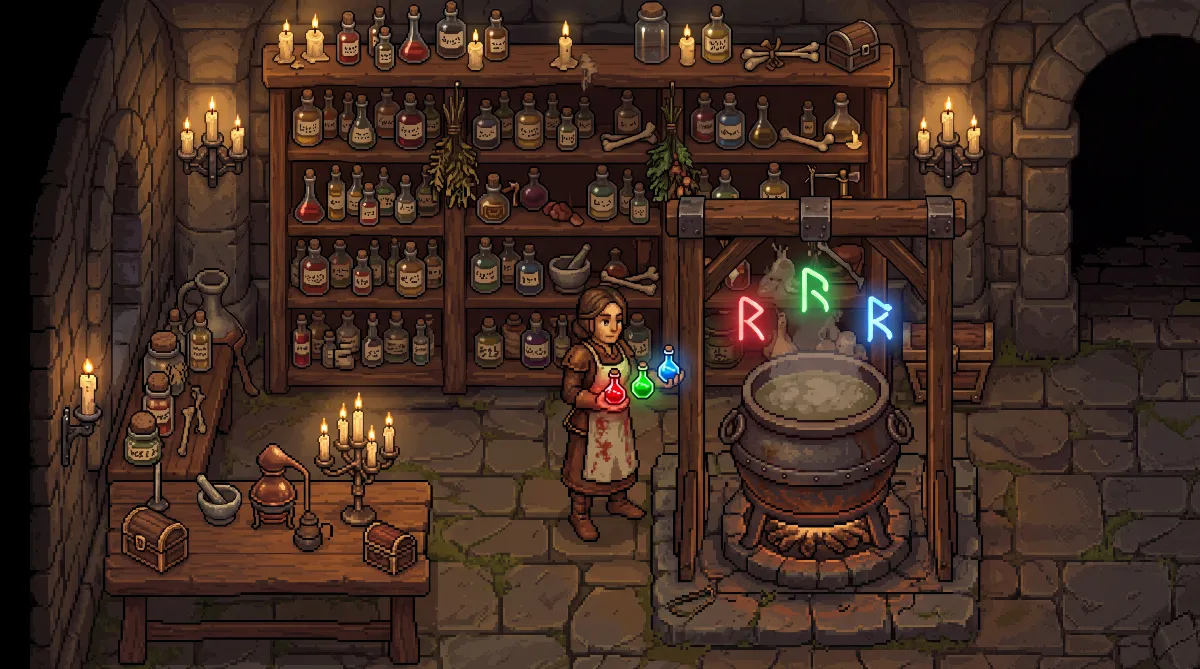
Graveyard Keeper 2 alchemy doesn't use fixed recipes. It uses runes: every ingredient carries red, green or blue runes, and your mix has to hit a potion's required rune total exactly. Once that clicks, you don't need to memorize a recipe list anymore.
This guide to Graveyard Keeper 2 alchemy explains the rune system, lists the ingredients with their values and gives you the complete recipe table. All core values were checked in the game itself. Community additions are marked as such.
🧪 How Alchemy Works in Graveyard Keeper 2
You brew in the laboratory. Laboratory I has two ingredient slots, Laboratory II has three. You put ingredients in, the game adds up their runes, and if the total matches a known potion exactly, you get that potion. Each brew also uses up an Alchemy Flask from the Flask shelf and some fuel. How to get more flasks is covered in the FAQ below.
There are three rune colors: red (lightning symbol), green (B symbol) and blue (arrow symbol). On some HDR screens the red rune looks more like magenta, but it is red.
Two rules decide everything. The total has to match exactly, and any excess in one color blocks the recipe. And you can reach at most five runes of one color per mix. On top of that, an ingredient has to be researched at the Study Table first. Otherwise the laboratory won't accept it at all.
🌿 Ingredients and Their Runes
You can check these values anytime in the game's rune book. The table sums up the most important basic ingredients for Graveyard Keeper 2 alchemy:
| Ingredient | Red | Green | Blue |
|---|---|---|---|
| Flesh | 1 | – | – |
| Red Mushroom | 2 | – | – |
| Stone | 2 | – | – |
| Copper Nugget | 2 | 1 | – |
| Tin | 2 | – | 1 |
| Beeswax | 1 | 2 | – |
| Leaf | – | 1 | – |
| Flour | – | 2 | – |
| Water | – | 1 | – |
| Blood | – | – | 1 |
| Minced Meat | – | – | 2 |
| Seed Oil | – | – | 1 |
| Peat | – | 1 | 1 |
You make Seed Oil at the Millstone, which makes it your most reliable blue source. Leaves drop with every harvest, and Flour comes from wheat. For red runes, use Stone, Tin or Flesh.
⚗️ All Graveyard Keeper 2 Alchemy Recipes
The table shows every formula with its rune total. As long as you hit that total with any ingredients, the potion works. Recipes with four or more runes of one color often need Laboratory II and its third slot.
| Formula | Rune total |
|---|---|
| Dream Dust | 1 green, 1 blue |
| Paint | 2 green |
| Lacquer | 2 blue |
| Healing Potion I / II / III | 2 / 4 / 5 red |
| Damage Potion I / II / III | 1+1 / 2+2 / 3+3 (red+green) |
| Zombie Motivator Potion I / II / III | 1+1 / 1+2 / 3+3 (red+blue) |
| Berserker Potion I / II / III | 1/1/1 · 2/1/1 · 3/2/2 (red/green/blue) |
| Weak Growth Elixir | 1 red, 2 green |
| Rich Growth Elixir | 1 red, 3 green |
| Miracle Growth Elixir | 1 red, 5 green |
| Preservative | 3 green |
| Organ Improver (red skull) | 4 red, 1 green |
| Organ Improver (white skull) | 4 green |
| Explosive Dust | 2 red, 2 blue |
| Spices | 2 green, 2 blue |
| Umami | 4 green, 4 blue |
| Reanimation Liquid | 2 red, 1 green, 4 blue |
| Third Eye Salt | 1 red, 5 blue |
For the master gear there's also Tannin Liquid (4 red, 2 green, 1 blue) for the armor and Alkali (1 red, 4 green, 2 blue) for the sword. The Philosopher Stone (3/3/3) is the only way to get Gold Nuggets at the Formulation Bench.
💡 Practical Example Mixes
The rune values above give you simple, reliable combinations. These work with common basic ingredients:
- Lacquer (2 blue): two Seed Oil. Used for Live Bait and other recipes.
- Preservative (3 green): Flour plus Water, or Flour plus Leaf.
- Organ Improver, red skull (4 red, 1 green): Stone plus Copper Nugget hits the total exactly.
- Explosive Dust (2 red, 2 blue): Tin plus Seed Oil. This dust is the base for dynamite.
- Miracle Growth Elixir (1 red, 5 green): Flour plus Beeswax plus Leaf, in Laboratory II with three slots.
All five mixes add up correctly by rune math. Tin plus Seed Oil for Explosive Dust and Stone plus Copper Nugget for the Organ Improver were confirmed in the game. If the laboratory shows the total you want, the mix works.
🔬 Researching Runes at the Study Table
Before the laboratory can count an ingredient, its runes have to be known. You read new ingredients at the Study Table. That costs Science, and for most ingredients 1 to 5 Faith on top. Community wikis disagree on whether the studied item is used up, so expect that you may lose one. After that the rune values appear in the rune book and the laboratory accepts the ingredient.
The 19 Alchemic Powders are a special case: they carry exactly the runes their name says, and they count as researched from the start. They're handy when you're missing a specific color, but they cost crafting effort. For everyday brewing, the basic ingredients from the table above are almost always enough.
A potion you brew successfully is also saved in the rune book. Over time, Graveyard Keeper 2 alchemy builds you a complete reference without any external list. That's the advantage of runes over fixed recipes: once you know your ingredients' values, you combine freely.
⚠️ The Most Common Graveyard Keeper 2 Alchemy Mistakes
Most failed mixes come down to a handful of causes. Know them and you waste far fewer ingredients:
- Color excess: one ingredient too many pushes a color over the required total. The recipe won't start, even though everything seems to fit.
- Wrong laboratory: recipes with four or five runes of one color need the third slot of Laboratory II. Laboratory I with only two slots often can't do it.
- Unresearched ingredient: until an ingredient is read at the Study Table, the laboratory won't accept it.
- Empty Flask shelf: without a free Alchemy Flask, the laboratory won't finish the mix. You make more at the Furnace from Glass.
- Red vs. magenta: on HDR screens the red rune looks magenta. It's the same color, count it as red.
🩸 What You Need the Potions For
Healing Potions and Damage Potions are for fights. The Damage Potion only boosts your own sword and bow, not your zombies or turrets. The Zombie Motivator Potion, on the other hand, speeds up your zombie warriors' attacks. The growth elixirs go into fertilizer and from there onto your garden beds, and the Miracle Growth Elixir is the base for the best farming fertilizer.
If you need more zombie helpers to unlock the anatomy and alchemy technologies, or more Graveyard Keeper 2 guides in general, check the Graveyard Keeper 2 hub. Guides for other games are on the banrado English start page.
❓ FAQ: Graveyard Keeper 2 Alchemy
Why can't I brew a potion even though I have the ingredients?
Usually the rune total isn't exact, or you have an excess in one color. Check the total against the recipe table. If the laboratory won't accept an ingredient at all, it hasn't been researched at the Study Table yet.
What does "research not completed" mean on a potion?
It only means you can already make the potion but its runes haven't been researched yet. You uncover runes at the Study Table by studying one of the item. The Folio, the rune book, is just the reference: a formula is written into it at the latest when you brew the potion successfully for the first time. Brewing still works, nothing is blocked.
How many runes of one color are possible?
Five. That's why recipes with four or five runes of one color often need Laboratory II with three ingredient slots to put the total together cleanly.
Are the runes red or pink?
Red. On HDR screens the red rune sometimes looks magenta, but in the game it's red.
Where do I get Alchemy Flasks?
You craft them yourself at the Furnace: the Alchemy Flasks I recipe turns 2 Glass and 10 Fuel into two Alchemy Flasks. According to community guides it needs Smithing mastery 2. Put the finished flasks on the Flask shelf in the laboratory, and every brew takes one from there.
To get started, community guides say the chest in the Abandoned Tower holds three sets of Alchemy Flasks I. Regular Empty Bottles, the kind you use for juice, don't work in the laboratory.
As of October 11, 2026: ingredient and elixir runes were checked in the game's rune book, the flask recipe at the Furnace II. The rest of the recipe list and the skull colors of the Organ Improvers come from the community wiki graveyard-keeper.wiki, Study Table costs and how the laboratory handles unresearched ingredients from the community wiki wikily.gg. English item and formula names follow the English community wikis (graveyard-keeper.wiki, wikily.gg). Mixes not individually confirmed in the game are based on rune math, so do a quick check in the laboratory. More guides on the Graveyard Keeper 2 hub.