Space Engineers Guide: Game Modes, Power and Survival Basics
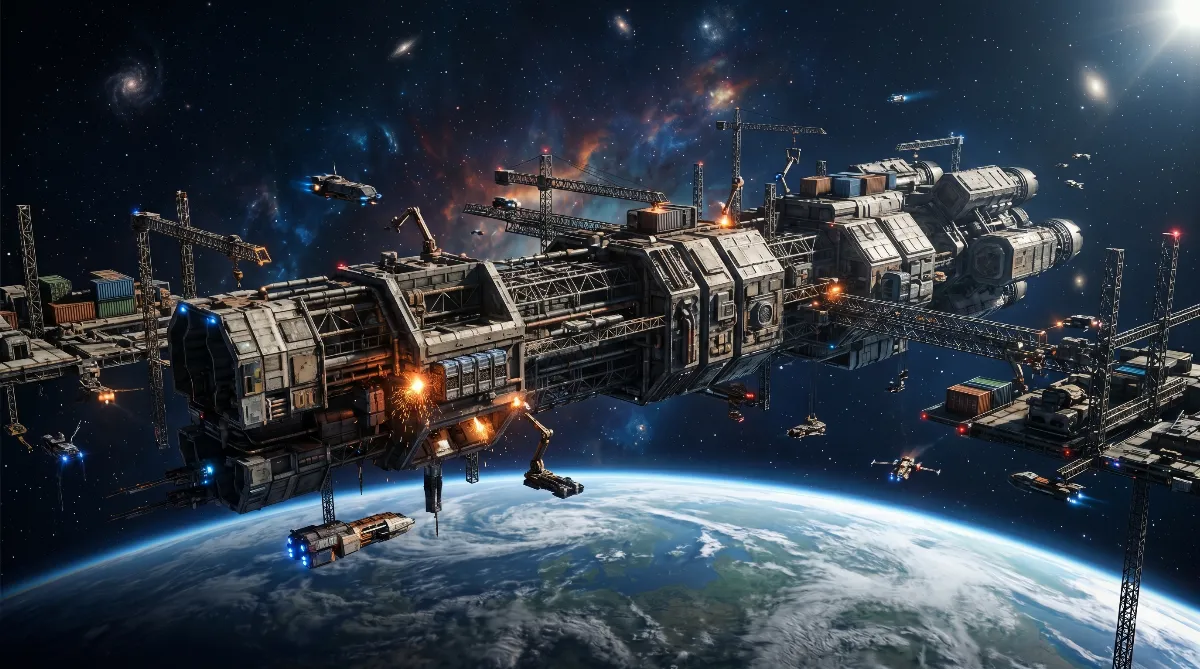
Space Engineers is a sandbox survival game where you build spaceships, bases and entire space stations yourself, block by block. This Space Engineers guide covers the basics in short form: the two game modes, the resource and power system, and what to watch out for as a beginner.
I bought the game in Early Access on Steam back in 2013 and have spent more than 500 hours in Survival mode since then. What started out as an overwhelmingly complex sandbox is still one of my favorite gaming experiences today. Here's my honest take.
What is Space Engineers?
It's a huge open-world sandbox survival game. You build your own spaceships, set up bases, explore planets and head out into space. Resources have to be gathered, mined and refined, and from those you make the components you need for everything else.
Creative or Survival: which mode fits you?
Creative mode: every block is available right away, no resources needed. Perfect for designing ships and bases without survival pressure.
Survival mode: you fight to stay alive. Find resources, mine them, refine them, then turn them into components for your base, your ship and finally the jump into space. This is where the game really shows what it can do.
How does power work in Space Engineers?
The game has a complex power system. You need electricity, fuel and raw materials to survive. Your power sources at a glance:
- Solar Panels — produce power as long as sunlight hits them
- Wind Turbines — only work on planets with an atmosphere; output depends on the wind and on free space around the turbine
- Hydrogen Engine — burns hydrogen made from ice and turns it into power
- Reactors — deliver a lot of power but consume uranium
- Batteries — store power for the night and for load spikes
Hydrogen has a second job too: Hydrogen Thrusters push ships through atmosphere and space, but they burn gas instead of electricity.
Power sources compared
Here's the same overview as a table, so you can see at a glance what each power source needs and where it works.
| Block | Needs | Where it works | Role |
|---|---|---|---|
| Solar Panel | Sunlight | Wherever the sun hits it | Power |
| Wind Turbine | Wind and free space around it | Only on planets with an atmosphere | Power |
| Hydrogen Engine | Hydrogen from ice | Anywhere | Power |
| Reactor | Uranium | Anywhere | Lots of power |
| Battery | Charging from other sources | Anywhere | Storage for night and load spikes |
| Hydrogen Thruster | Hydrogen gas | Atmosphere and space | Propulsion, not a power source |
My videos
Two early episodes from my Let's Play series. The commentary is in German, but they're a good watch alongside this guide if you're just starting out:
Starting the new Space Engineers
A new world: the start of Survival
Pros and cons after 500+ hours
PROS:
- Endless ways to solve every problem
- Very good physics engine compared to other sandbox games
- Stable performance even with big builds
- Huge creative freedom, from go-karts to a Death Star base
CONS:
- Occasional small graphics glitches
- Rare bugs with ships
- Autopilot can be unreliable
What about the sequel, Space Engineers 2?
Space Engineers 2 has been in Early Access since January 2025. It brings the new VRAGE3 engine and a unified 25 cm building grid. Multiplayer is still missing there: four-player co-op is planned for early 2027 according to the roadmap. If you want to build together right now, stick with the first game.
If you're coming from the first game, we already have a whole series of guides: the beginner's guide to get started, a walkthrough for your first ship with grid and thrusters, the Space Engineers 2 roadmap, and a comparison of Space Engineers 2, SpaceCraft and Planet Crafter in case you haven't picked a space building game yet.
Conclusion: is Space Engineers worth it?
If you're looking for a block-based space survival crafting game, you're in the right place. The game is a lot more than placing blocks, and after 500+ hours I'm still hooked. Important: set your own goals, or it gets repetitive fast. With goals, though? Endless sandbox freedom in space. 🚀
FAQ: Space Engineers guide
Can you play Space Engineers solo?
Yes. You can play both Creative and Survival mode completely on your own. For building together there's multiplayer as well.
What's the difference between Creative and Survival mode?
In Creative mode every block is available instantly and without limits. In Survival mode you have to mine resources, refine them and turn them into components before you can build.
What power sources are there in Space Engineers?
Solar Panels, Wind Turbines (only on planets with an atmosphere), Hydrogen Engines and uranium Reactors. Batteries store the power. Hydrogen Thrusters are propulsion, not a power source.
Should I play Space Engineers or Space Engineers 2 with friends?
The first game. Space Engineers 2 has been in Early Access since January 2025 and has no multiplayer yet. Four-player co-op is planned for early 2027 according to the roadmap, so if you want to build together right now, the original is the one to pick.
Is Space Engineers still worth it today?
Yes. The game runs stable, offers huge creative freedom, and with your own goals it stays motivating for a long time. If you want the newest tech, take a look at Space Engineers 2 alongside it.
As of October 2026. Block names as they appear in the English version of Space Engineers.
