Dune Awakening Sandworm Guide: Aggro, Safe Rocks and Thumpers
- 🗺️ What Attracts the Sandworm in Dune Awakening
- 📦 How to Read the Dune Awakening Threat Meter
- 💡 Timing: The Three Phases of an Attack
- ⚒️ Safe Rocks and Route Planning
- 🧪 Thumpers: Sending the Worm Somewhere Else
- ☢️ What's Different in the Deep Desert
- 🩸 What You Lose When a Worm Eats You
- ✨ Checklist Before Every Sand Crossing
- 🔗 FAQ: Dune Awakening Sandworm
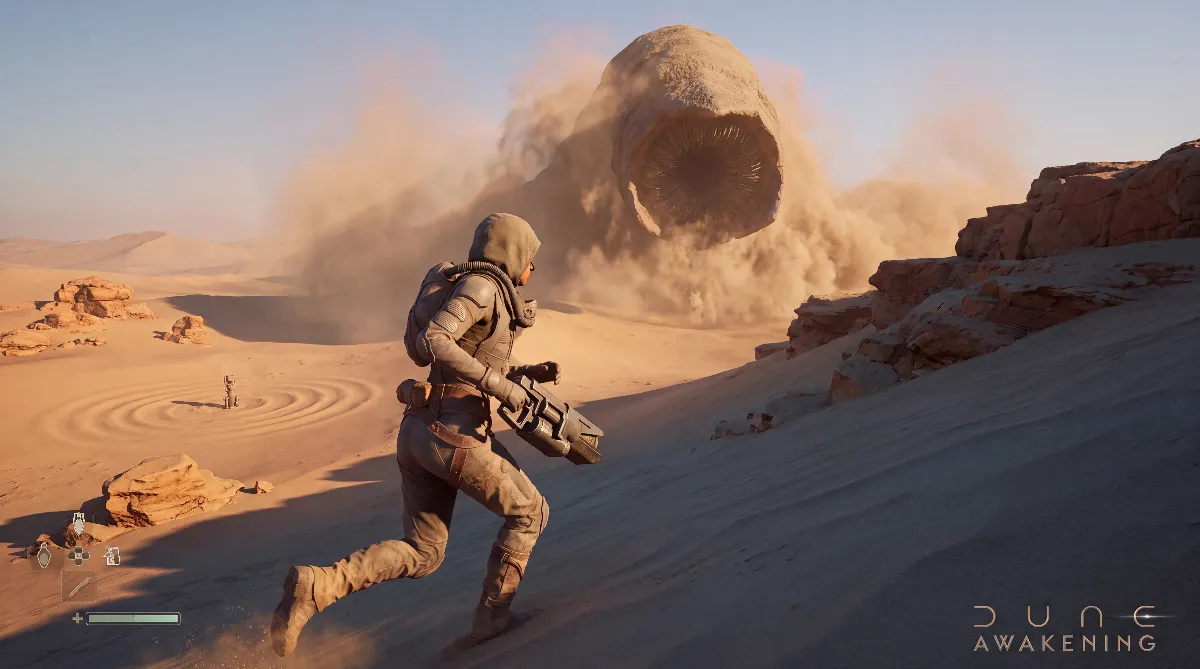
The Dune Awakening sandworm isn't drawn in by noise. It follows vibration. Every step on open sand, every ground vehicle and every active Holtzman field fills up a threat meter on your screen. On rock you're safe. On open sand you never are.
This guide explains what the meter means, how much time you have after the worm breaks the surface, how Thumpers work, what's different in the Deep Desert and what you actually lose when a worm gets you.
🗺️ What Attracts the Sandworm in Dune Awakening
Shai-Hulud doesn't hunt players. It follows tremors. Funcom hasn't published any numbers on worm aggro. The list of triggers below comes from community collections and isn't officially confirmed, but it matches what you see in the game:
- Moving on open sand, scaled by speed: crouch-walking makes little vibration, walking a medium amount, sprinting the most.
- Ground vehicles like the sandbike, which leave a constant trail.
- Low-flying Ornithopters. Flying reduces the problem but doesn't remove it.
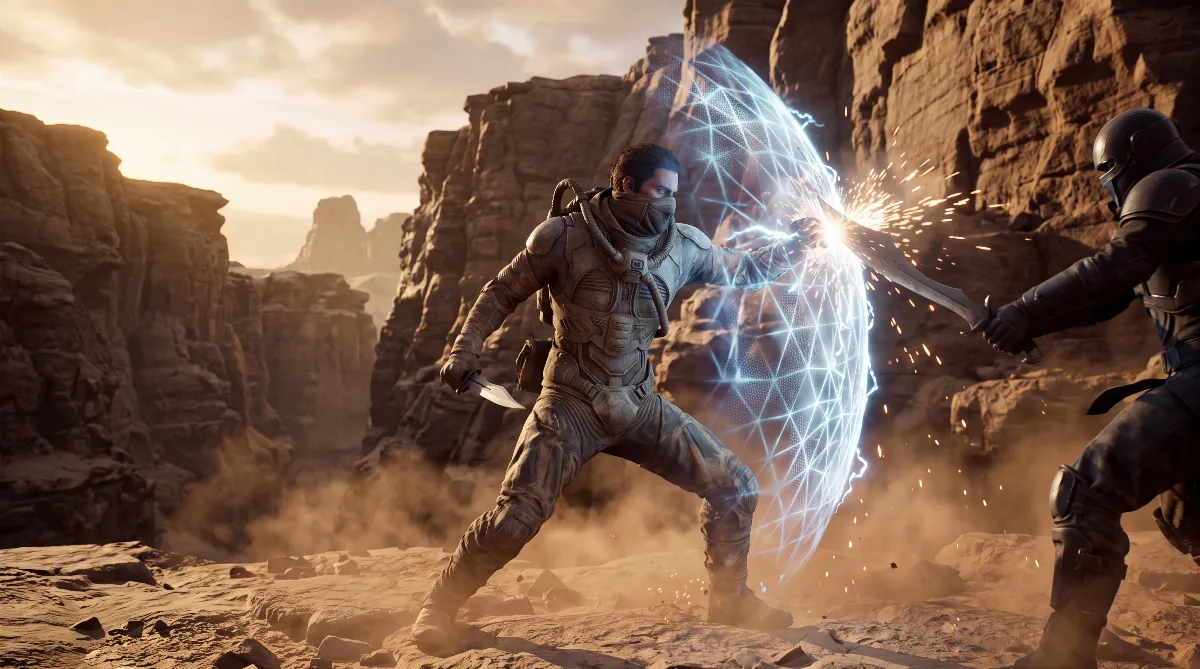
- Active Holtzman tech, meaning personal shields and suspensors.
- Using tools, mining and firefights out on the sand.
- Drumsand: areas marked red that amplify every movement massively.
Drumsand is the most expensive beginner mistake. These areas are marked red on the map and you can spot them in the terrain by their lighter surface. And Flour Sand almost always sits right on top of them, so mining there practically calls the worm to you. Plan your route around red areas instead of cutting through them.
📦 How to Read the Dune Awakening Threat Meter
As soon as you step onto open sand, the game shows a vibration meter. According to consistent community descriptions, it has three stages: white to yellow means low vibration, orange means a worm has noticed you, and red means it's on its way to break the surface.
Two details a lot of players miss. First, the moment you step onto rock, the meter disappears. The value doesn't drain slowly, it drops away completely. Second, the worm doesn't surface right next to you but at a random spot in the area around you. The distance it has to cover is your real grace period.
In practice, the meter decides whether you mine one more patch or call it. From orange on, pull back. From red on, take the shortest path to the nearest rock and nothing else.
💡 Timing: The Three Phases of an Attack
Based on community observation, small worms attack in three steps: first a visible warning breach, then a short grace period, then the deadly strike. That middle phase is all you get. It's not there to grab the last bit of ore. It's there to run.
Once the worm visibly breaks the surface, crouching won't help anymore. From that moment, only speed toward rock counts. Movement abilities like Bindu Sprint belong right here, not at the start of a trip, or they'll be on cooldown when you need them.
Vehicles buy you distance, not safety. A sandbike is faster than you on foot, but it leaves its own vibration trail. For short hops to the next rock it's the right choice, as a permanent solution on open sand it isn't. How to unlock and fuel one is covered in our Dune Awakening sandbike guide.
⚒️ Safe Rocks and Route Planning
Rock is the only reliable cover in Dune Awakening. Worms can't reach stone surfaces, plateaus or rock bases. That changes how you move across the map: you don't plan the shortest line but a chain of rock islands with only short stretches of sand between them.
Three rules that hold up in everyday play:
- Always park your Ornithopter and sandbike on rock, never on sand.
- Place respawn beacons on rock so you come back close to your route after a mistake.
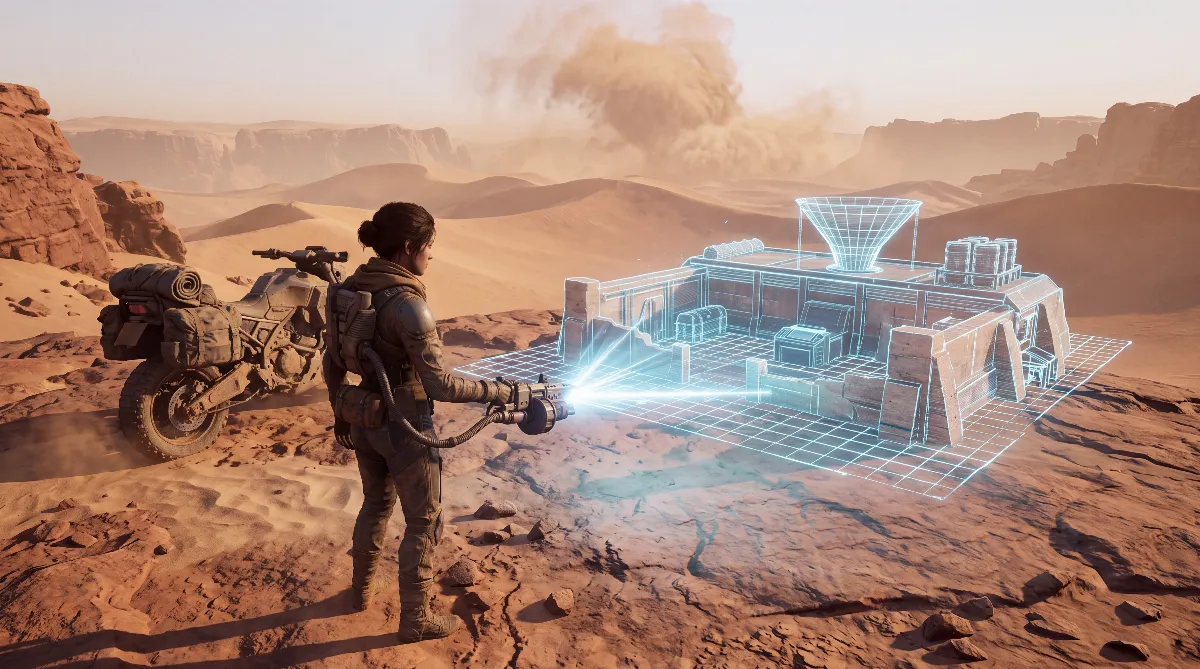
- Build bases and storage at rock formations. That also keeps worm aggro away while you load and unload.
Gear helps too. Softstep Boots noticeably cut the vibration from walking on sand and should go on before any longer sand stretch. Skip them and you make life harder than it needs to be. See also our Dune Awakening beginner tips.
🧪 Thumpers: Sending the Worm Somewhere Else
The Thumper is the only tool in Dune Awakening that actively redirects the sandworm. You set it up away from your harvesting zone, it makes strong vibrations, and the worm heads for it instead of you. According to the game-data database dune.gaming.tools (not confirmed by Funcom), the numbers look like this:
| Stat | Value |
|---|---|
| Tier | Tier 3 (Common) |
| Duration | 300 seconds |
| Worm Attraction Intensity | 5,000 ("Extreme") |
| Crafting | Survival Fabricator, 20 seconds |
| Materials | 35x Water, 5x Steel Ingot, 4x EMF Generator, 3x Silicone Block |
| Vendor price | 2,500 Solari from Dr. Shaffat or Fleshshaper Phrakk |
The 35 units of water per Thumper are the real cost. That's why Thumpers pay off mostly when harvesting spice as a group, where one person rotates the Thumpers while the rest harvest. The harvesting routine is covered in our Dune Awakening spice farming guide.
A Thumper doesn't make you invisible. It only shifts the worm's attention to another spot, and only for five minutes. Sprint across Drumsand during that time and you'll still bring the worm to you.
☢️ What's Different in the Deep Desert
Worm density goes up a lot in the Deep Desert. The community wiki counts around ten small worms in the Hagga Basin compared to up to about fifty in the Deep Desert. That number isn't officially confirmed. In practice it means shorter sand stretches, less buffer and more stops on rock.
There's also a worm variant you only find there. According to the community wiki, the Grandfather Worm only shows up under tight conditions: two to four players, 1,000 Spice Sand gathered, at least 1,000 meters from a server border and a large crater spice field. The wiki itself calls these rules somewhat fluid.
Since Update 1.3.20.0 from April 28, 2026, the Deep Desert has officially been split into separate PvE and PvP instances. That changes nothing about the worm; it eats you the same way in both. In the PvP instance, other players can also get in the way of your escape route. More in our Deep Desert PvE guide.
🩸 What You Lose When a Worm Eats You
This is the real difference from every other death in Dune Awakening. On a normal death, part of your stuff stays at the spot where you died and you can loot it back. When the worm swallows you, there's no loot spot, because there's no body.
| Situation | Gear and inventory | Vehicle |
|---|---|---|
| Normal death | Part of your items stays at the death spot and can be recovered | Stays where it was |
| Death by sandworm | Everything you carried is gone for good | Can be recovered through vehicle recovery |
Funcom improved things for vehicles. Patch 1.2.10.0 from October 7, 2025 added a recovery system: a vehicle eaten by a worm can be brought back for a Solari fee, but it loses 15 percent of its maximum repairable durability per recovery. Back then the window was 72 hours, and you could queue up to five vehicles for recovery at once. Funcom's Update 1.5 announcement ("The New Dune: Awakening Is Here") now gives a longer window: destroyed vehicles can be recovered for up to 30 days, for a Solari fee and a durability penalty. The announcement doesn't say whether the 15 percent and the five-vehicle limit still apply.
That doesn't apply to your character. According to the community wiki, only the Vehicle Backup Tool and quest items survive the worm. Everything else in your pack is gone. As compensation you respawn with a Worm Tooth, which you can craft into an Unfixed Crysknife. If your very first death is to a worm, the game also gives you a replacement sandbike.
✨ Checklist Before Every Sand Crossing
- Plan your route over rock islands and go around red Drumsand areas.
- Wear Softstep Boots and switch off shields and suspensors on open sand.
- Only carry what you can afford to lose. Store loot along the way instead of hauling it.
- Place a respawn beacon on rock before you head out onto the sand.
- Back off at orange, and at red go straight to the nearest rock.
- Save movement abilities for the escape, not for the trip out.
🔗 FAQ: Dune Awakening Sandworm
Can you kill the sandworm in Dune Awakening?
No. The sandworm isn't an enemy with a health bar but an environmental event. No weapon and no build stops it. The only answer is rock.
How far does safety on rock reach?
Any connected stone surface counts, including small plateaus and rock bases. The threat meter disappears as soon as you step on it. Sand between two rocks is fully dangerous, though, no matter how narrow it is.
Does an Ornithopter protect you from the worm?
Flying is the safest way to cross sand because you don't touch the ground. It's not a guarantee: landing and taking off on sand create vibration, and the community describes low flying as risky.
Are Thumpers worth it for solo players?
Rarely. 35 units of water per Thumper is expensive when you're alone, and the distraction only lasts 300 seconds. Solo, you're better off with short sand stretches and Softstep Boots.
Do I get my gear back after a worm death?
No. Gear and backpack contents are gone for good, because no body is left behind. Only vehicles can be recovered through the recovery system, for a fee and a durability loss.
Did Update 1.5 change the sandworm in Dune Awakening?
Not its behavior, as far as we can tell. Update 1.5 has been live on all platforms since September 17, 2026 and mainly brought the single-player mode. Its list of single-player settings does include a "Sandworm auto-spawn" option; the patch notes don't explain exactly what it controls. Changes to aggro or Thumpers don't show up in the Update 1.5 notes or in the hotfixes up to 1.5.3.7 from October 9, 2026. For vehicle recovery, Funcom's Update 1.5 announcement gives a window of up to 30 days instead of the earlier 72 hours.
As of October 11, 2026: the live build is Hotfix 1.5.3.7 (October 9, 2026). Officially documented by Funcom are the vehicle recovery system from Patch 1.2.10.0 (October 7, 2025) with its original 72-hour window and 15 percent durability loss, the recovery window of up to 30 days from Funcom's Update 1.5 announcement (September 17, 2026), and the PvE/PvP split of the Deep Desert from 1.3.20.0 (April 28, 2026). Thumper stats come from the game-data database dune.gaming.tools.
Marked as community information and not officially confirmed: the threat meter stages, the aggro triggers, the worm counts for the Hagga Basin and the Deep Desert, and the conditions for the Grandfather Worm. Sources: duneawakening.com patch notes and news, awakening.wiki, dune.gaming.tools. Dune Awakening has no official wiki. More guides on the Dune Awakening hub.