StarRupture Automation 2026: Power, Rails and Production Chains
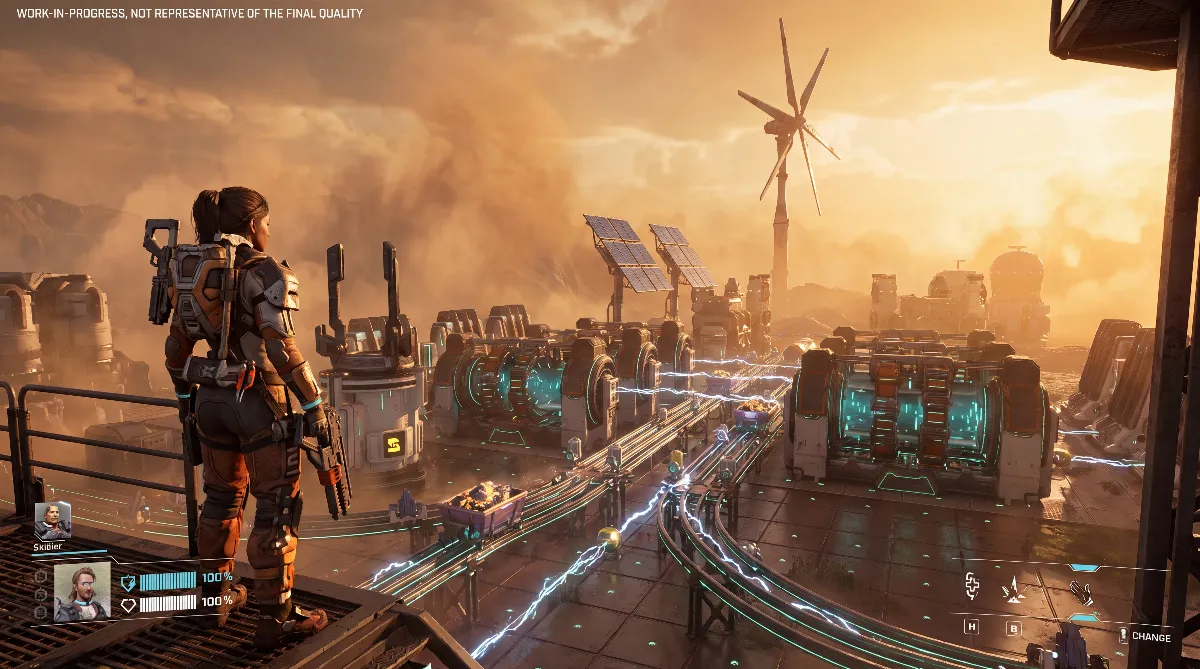
StarRupture automation rests on two systems: the power grid and the material chain, and both run through the same element, the rails. Once you understand how power flows and in which ratios machines produce, you build clean from the start instead of tearing everything down later.
This guide sums up the current Early Access state and works through the key production ratios with concrete numbers.
⚡ How Power Works in StarRupture
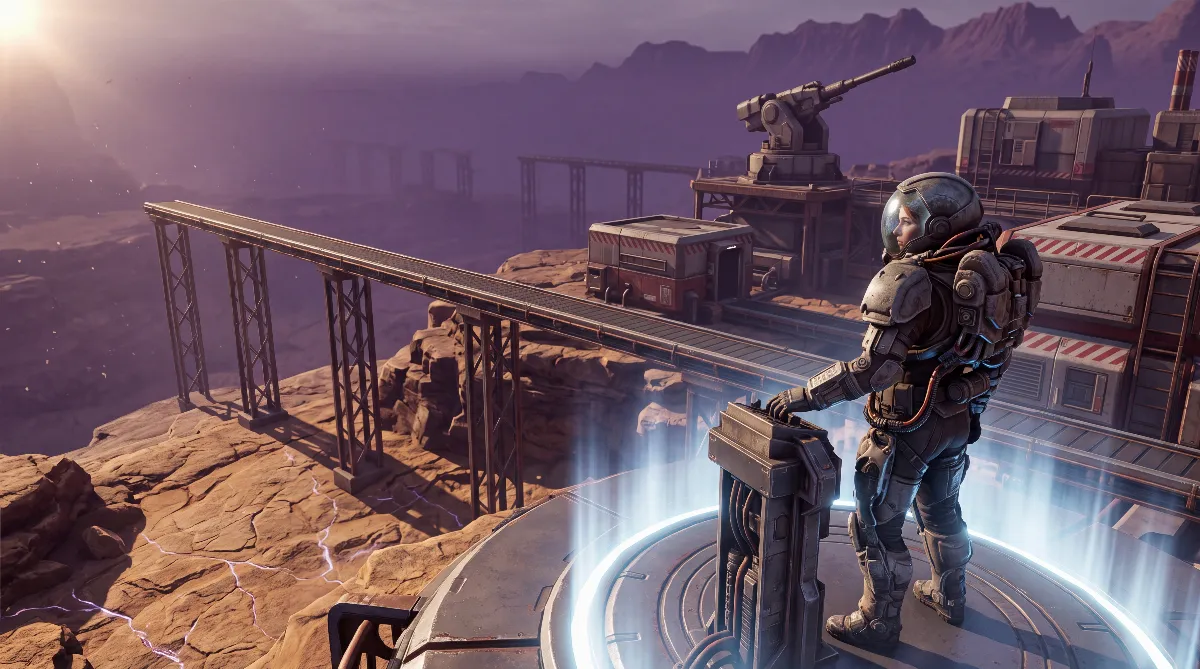
StarRupture does without cables entirely. Instead, rails, platforms, stairs and base parts carry the power. The physical structure of your base is your power grid at the same time. Everything that's connected shares one grid. A machine doesn't have to stand right next to a generator; it only has to be linked to the grid through rails or foundations.
That has one important consequence: power almost never drops because of missing parts, but because of a broken connection. If a machine won't run, first check the unbroken rail chain back to the generator, and only then whether there's enough output in the grid at all. You can switch off individual machines to save load during a rebuild.
☀️ Solar Generators and How They Scale
The Solar Generator v.1 is your first power source and comes with Moon Energy level 1, right at the start. It's cheap to build but delivers little output per unit and only produces in daylight. According to community planners, a first small StarRupture automation setup typically needs three to five of them, more than the raw wattage suggests, because nothing comes in at night.
Keep in mind: solar scales poorly across your base, because every generator eats space. The real jump comes later with wind turbines.
| Generator | Output | Unlock |
|---|---|---|
| Solar Generator v.1 | 10 MW (daylight only) | Moon Energy level 1 |
| Wind Turbine v.1 | 1,200 MW | Moon Energy level 9 |
| Solar Generator v.2 | 140 MW | Upgrade at the Development Station |
| Wind Turbine v.2 | 3,200 MW | Upgrade at the Development Station |
On paper, one Wind Turbine v.1 replaces 120 Solar Generators v.1 (1,200 MW against 10 MW), and it doesn't depend on daylight. That makes it the first real milestone that changes how you build: after it, you stop thinking about power in terms of solar fields. Solar Generator v.2 and Wind Turbine v.2 aren't level rewards: you buy them as upgrades at the Development Station (Moon Energy level 5) once its tasks are done. Solar v.2 is mainly a way to pack more power into less space, and its unlock costs Quartz Ore, among other things; where to get it is covered in the guide to Quartz farming.
The MW values and power draws in this guide come from metaforge.app, a database built from the game files. The unlock levels come from the community-run StarRupture wiki on wiki.gg, which reflects the reward tree after Update 1. Both can shift with patches, so check the in-game numbers when in doubt.
🔗 Rails as Your Power and Logistics Network
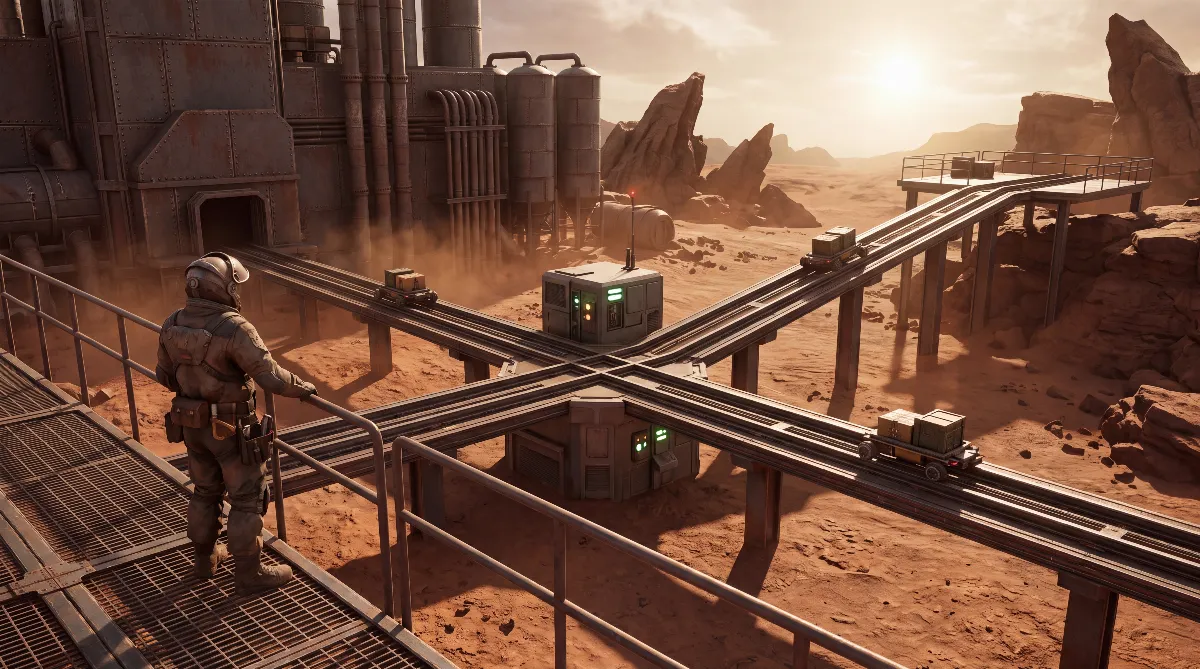
The drone rails (Rail v.1 to v.3) do double duty in StarRupture: drones on them move materials, and the rails carry power at the same time. Rail v.1 handles 120 items per minute. That's exactly what makes them the backbone of every StarRupture automation build. With Rail Supports you route the rails around obstacles, and with Rail Connectors you bundle several inputs into one target machine. How to cross rails, handle slopes and clear bottlenecks is covered in our guide to StarRupture drone rails.
A recurring stumbling block is the Ore Excavator. You can't attach a generator or foundation to it directly, so a solar generator placed next to it won't power it. The fix: connect the excavator by rail to a machine that's already powered, such as a Smelter. As long as the Smelter is on the grid, the excavator draws its power through the rail. This one rule explains most "my excavator won't run" cases for beginners.
⛏️ The Chain: Ore Excavator, Smelter, Fabricator
The core production chain is straightforward. The Ore Excavator goes directly onto an ore deposit (such as Wolfram, Titanium or Calcium) and mines automatically. Rails carry the raw ore into the Smelter, which turns it into bars. Another rail leads from there into the Fabricator, which processes bars into components such as sheets. At the end of the chain you'll often find the Orbital Cargo Launcher, which sends finished goods to the corporations.
| Machine | Power draw | Throughput |
|---|---|---|
| Ore Excavator | 5 MW | ~60 items/min |
| Smelter | 5 MW | ~60 items/min |
| Fabricator | 10 MW | ~60 items/min |
Because current data puts all three stages at about 60 items per minute, you get a clean 1:1:1 ratio: one excavator supplies exactly one Smelter, which feeds exactly one Fabricator, with no jams and no idle time. The ratio only shifts when a recipe runs slower or needs several inputs.
💡 The StarRupture Automation Rule of Thumb
Here's the data point that lets you estimate your power and build planning at a glance. A complete 1:1:1 line of Ore Excavator, Smelter and Fabricator draws:
- 5 MW + 5 MW + 10 MW = 20 MW per production line.
- That equals two Solar Generators v.1 (2 × 10 MW) on paper; because they only run in daylight, plan on three to five in practice.
- A single Wind Turbine v.1 (1,200 MW) covers about 60 of these lines on paper.
For your automation planning in practice: plan roughly 20 MW plus a small buffer per Fabricator line. The infamous "power wall" moment usually hits with your first bigger Fabricator stack, exactly when several machines start up at once and the solar park can't keep up. If you've worked toward the wind turbine by then, you skip the problem. For a concrete advanced resource, see our guide to mining Goethite Ore.
❓ Frequently Asked Questions about StarRupture Automation
Why isn't my Ore Excavator getting power?
Because you can't attach a generator or foundation to the excavator directly. Connect it by rail to a machine that's already powered, such as the Smelter, and it draws power through the rail.
Do I need cables for the power grid?
No. Rails, platforms and base parts carry the power themselves. An unbroken connection to the generator is enough, no matter how far away the machine stands.
How many solar generators do I need at the start?
On paper, two Solar Generators v.1 (about 20 MW) cover a single Excavator-Smelter-Fabricator line. Because solar only delivers in daylight, community planners recommend three to five for a stable start. For several lines, switching to the Wind Turbine v.1 pays off fast.
In what ratio should I build the machines?
At roughly 60 items per minute per stage, it's 1:1:1: one excavator, one Smelter, one Fabricator. Slower recipes or recipes with several inputs shift the ratio.
Why does a machine stop even though I have generators?
Almost always because of a broken connection, not missing parts. Check the rail chain back to the generator first, then whether the grid has enough output.
✨ Conclusion
StarRupture automation is surprisingly predictable once two things click: rails are your power and logistics network in one, and the core chain runs at a 1:1:1 ratio at about 60 items per minute. Plan roughly 20 MW per Fabricator line, keep your rail connections unbroken and work toward the Wind Turbine v.1 to skip the first power bottleneck.
All figures in this guide were checked against the sources named above. Since StarRupture is in Early Access, values, recipes and unlocks can change with upcoming patches, so double-check the current in-game values when in doubt.
As of: October 8, 2026, Early Access after Update 2 "Quality of Life" (September 2, 2026).