Subnautica 2 Base Building: Build Order, Integrity and Power (2026)
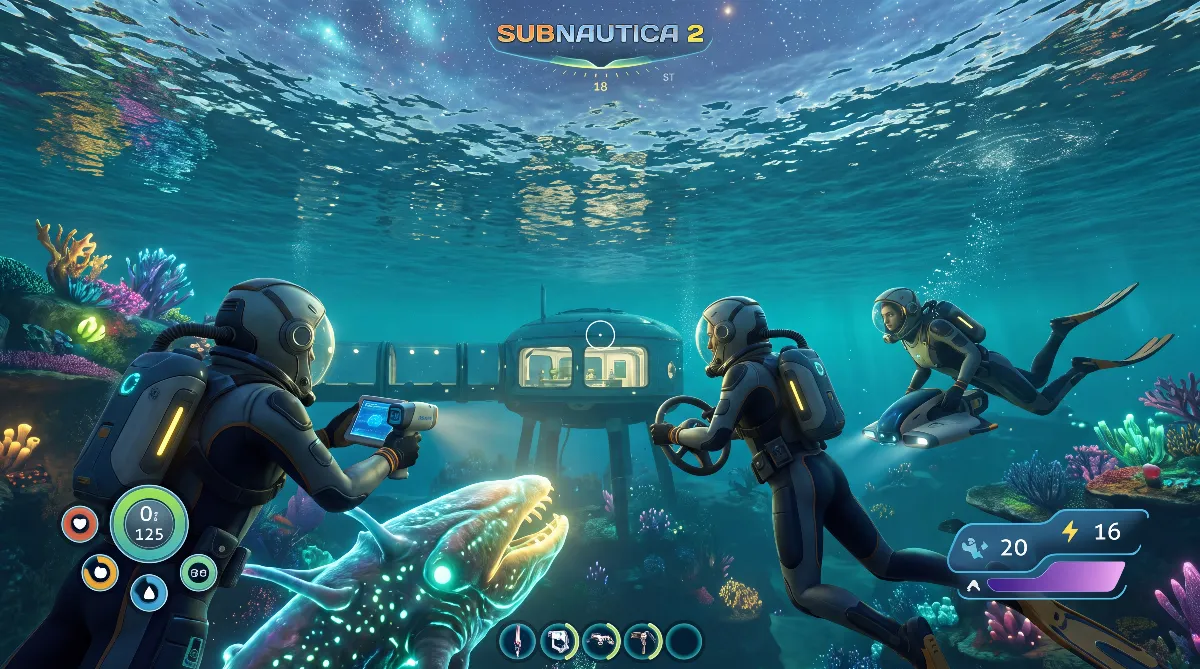
- 🔧 First: The Habitat Builder
- ⚠️ The Most Important Rule: Hull Integrity
- 📍 Where to Build: Start Shallow
- 🧱 The Build Order for Your First Habitat
- ⚡ Pick Power by Depth
- 🌊 Building Deeper: Match the Hull to the Depth Band
- 🩹 What Recent Updates Changed
- 🤝 Coordinating in Co-op
- 🏝️ Several Small Outposts Instead of One Giant
- 📊 Subnautica 2 Base Building at a Glance
- ❓ Frequently Asked Questions about Subnautica 2 Base Building
For Subnautica 2 base building you first need the Habitat Builder and then a fixed order: foundations, then rooms, then a Hatch, then power. The one rule that decides between success and a flooded habitat is hull integrity, and you protect it by placing foundations before you build anything else.
This guide shows you the right build order, how integrity works, where to start and which power source fits which depth. Game version: Buddy System Hotfix 1 from September 1, 2026.
A note on sources: Subnautica 2 has been in Early Access since May 14, 2026, costs $29.99 during this phase and runs on Windows PC and Xbox Series X|S. There is no PlayStation version. Unknown Worlds doesn't document building values in detail, so every number below comes from fan guides and is labeled as such.
🔧 First: The Habitat Builder
No tool, no home: the Habitat Builder is the requirement for everything else. You can craft it early and cheaply, mostly from Titanium, some Glass and simple electronics. Build it as soon as you have gathered the first resources around the Lifepod. Exact amounts can still change during Early Access.
With the Habitat Builder you pick a module, position it as a hologram preview in the world and confirm. Only then are the materials used up, so you can plan safely before you commit. Since the "Buddy System" update, additional alignment guides make placing modules noticeably cleaner.
⚠️ The Most Important Rule: Hull Integrity
Your whole structure shares a single integrity value. Almost every module subtracts from it: rooms, corridors, windows in particular, and even more so at depth. If the value drops below zero, leaks break open and everything floods. That is by far the most common source of frustration for new players.
The countermeasures are foundations and reinforcement panels. Foundations are cheap and should always go down first, while reinforcement panels add a lot more and can also be attached later. Hence the golden rule: place two or three foundations on flat seafloor before you build your first room.
Community data: fan guides list around two to three integrity points gained per foundation. The studio officially quantifies neither that value nor the deductions of individual modules. So trust the readout in the Habitat Builder rather than numbers from guides. When in doubt, the readout is the only reliable source.
📍 Where to Build: Start Shallow
Build your first habitat deliberately shallow, in a calm starting area. Solar power is reliable there, there are hardly any big predators, and integrity costs are at their lowest, so you have the most room for beginner mistakes. As a rule of thumb, fan guides name a range of about 50 to 200 meters; there's no official figure.
The reason behind that advice is undisputed: depth multiplies the integrity cost of every module. A deep structure with a basic hull floods while you're still building it. Keep your first one in shallow water and only go deeper once you have unlocked reinforcements.
🧱 The Build Order for Your First Habitat
In Subnautica 2 base building, keep it simple and go in this order: first two or three foundations, then a Corridor or Room, then a Hatch as your way in and out. The Hatch seals the structure so it supplies you with oxygen as soon as it has power.
After that come two Solar Panels, a Fabricator and some storage. Your first habitat doesn't need more. A layout tip: build up rather than out. Stacked modules cost less integrity than modules spread across the floor, and you save walking time when you cluster workshops close together.
From the start, also leave room for what comes later: a dock for the Tadpole, larger storage, a second exit toward your next dive target. If you box yourself in, you'll tear down more than you build later, and every rebuild costs material again.
⚡ Pick Power by Depth
The most common follow-up mistake is the wrong power source. Solar Panels only deliver reliable energy in shallow water and fail at depth. For your shallow starter habitat they're more than enough: two of them carry a Fabricator and lights.
As soon as you build deeper, you need a different source: a Thermal Plant at a hot vent or an organically fueled alternative. Plan for it before you move into a deep biome. Without power, a habitat seals in no oxygen and protects nothing.
🌊 Building Deeper: Match the Hull to the Depth Band
Every hull section is designed for one depth band. A basic hull holds in the shallow starting area, a reinforced hull in the middle range, advanced reinforcement in the deep zones. Always build for the depth you're at, not the one you're planning for.
The catch: integrity is cumulative. A single section that's too weak in an otherwise well-built structure drags the whole thing below zero and floods everything. Reinforcement panels raise the effective strength of an existing hull without a rebuild. Place them before you expand, not when the first leak starts spraying.
🩹 What Recent Updates Changed
Building came up in both major updates. Early Access 1.1 "Adaptive Measures" from July 8, 2026 cleaned up a wide range of bugs. According to the patch notes, Early Access 1.2 "Buddy System" from August 19, 2026 brought better alignment guides and improvements to module placement, exactly where new players used to struggle most.
Buddy System Hotfix 1 from September 1, 2026 followed up with several concrete fixes: items on wall racks not being properly refunded when you use Refund Base, and exterior furniture in multiplayer. If you lost material while deconstructing or had trouble with outdoor furniture in co-op, simply updating helps.
On September 3, Unknown Worlds extended the same hotfix. According to the announcement, it fixes Axum Powerplant Turbines that disappeared or could no longer be completed mid-construction; affected players get the construction ghost back and can finish the turbine for free. It also brings further base, creature, vehicle and multiplayer fixes.
Important for planning: the official Early Access roadmap gives no dates for the next update and no name either. It only announces the order: smaller improvements first, larger expansions later. Anyone promising you a date for building changes is guessing.
🤝 Coordinating in Co-op
In multiplayer, integrity quickly becomes a trap: when several players add rooms independently at the same time, the shared value drops below zero before anyone notices. Agree on who expands, and pick one person to keep an eye on integrity and power.
Deconstructing needs coordination too, because in co-op everyone can change everything.
🏝️ Several Small Outposts Instead of One Giant
A common mistake is the one central habitat that keeps growing. In Subnautica 2 you often get further with a network of several small outposts: one shallow main habitat and one or two small outposts closer to the targets of your next dives.
That saves long trips, keeps the integrity of each outpost manageable and gives you spare oxygen and a Fabricator within reach everywhere. Because Subnautica 2 rewards exploration, an outpost network is usually more efficient than a single colossus that hits the integrity limit with every expansion.
📊 Subnautica 2 Base Building at a Glance
| Step | What you do |
|---|---|
| Tool | craft the Habitat Builder early |
| First | 2–3 foundations on flat ground |
| Then | Corridor/Room, then Hatch |
| Power, shallow | two Solar Panels |
| Equipment | Fabricator and storage |
| Depth | match the hull to the depth band |
| Power, deep | Thermal Plant instead of solar |
| Latest version | Buddy System Hotfix 1, 09/01/2026, extended 09/03/2026 |
❓ Frequently Asked Questions about Subnautica 2 Base Building
Why does my habitat keep flooding?
Because hull integrity has dropped below zero. Place foundations and reinforcement panels before you expand, and match the hull to the depth you're building at.
What do I build first?
First two or three foundations, then a Corridor or Room, then a Hatch, then two Solar Panels, a Fabricator and storage. That's enough for your first habitat.
How deep can my first habitat be?
Keep it shallow in the calm starting area, where solar power is reliable and integrity costs are low. The often-quoted range of 50 to 200 meters is a community rule of thumb, not an official figure.
Which power source works at depth?
Solar fails at depth. Use a Thermal Plant at a hot vent or an organic alternative before you build deep.
How do I fix a flooded habitat?
Leave it, add reinforcement panels until integrity is back above zero, go back inside and fix the individual leaks with the Repair Tool.
Is one big structure or several small ones better?
For Subnautica 2 base building, several small outposts are often more practical: they stay above zero integrity more easily, save trips and give you oxygen and a Fabricator everywhere. One giant structure hits the limit faster.
As of: October 8, 2026, game version Buddy System Hotfix 1 from September 1, 2026, including its extension of September 3. No newer patch had been released by then. Officially confirmed are the Early Access start, price and expected duration, the platforms Windows PC and Xbox Series X|S, and the building-related changes in updates 1.1 and 1.2 and Hotfix 1. Sources are the Steam page, the Steam news feed and the Early Access roadmap from Unknown Worlds, which gives no dates for upcoming updates.
Explicitly community data are all building numbers: the integrity gained per foundation, the deductions of individual modules and the depth range for your first habitat. Subnautica 2 has no official wiki; these values come from fan guides and Steam discussions and can change with any update. The integrity readout in the Habitat Builder always has the final say.